
ART THAT ATTENDEES CAN ALSO USE: PORTABLE RESTROOMS HIGHLIGHT THE BIENNALE ARTE 2026 IN VENICE
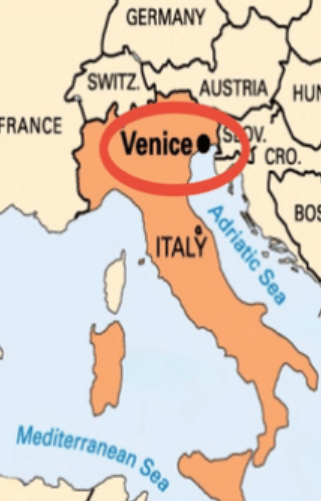
Our industry is playing a starring role in this internationally renowned art show currently running in Venice, Italy until November 22nd. The 61st Biennale began on May 9 and I was fortunate enough to attend on May 30th. I can personally attest that our industry is indeed part of the most popular exhibit at this event!
WHAT IS “BIENNALE”?
Founded in 1895, this is one of the world's most renowned international art exhibitions.

Held on a bi-annual basis, the 2024 event drew some 800,000 attendees and this year’s show is expected to draw close to that same attendance figure. This year 99 countries and territories are represented at Biennale.
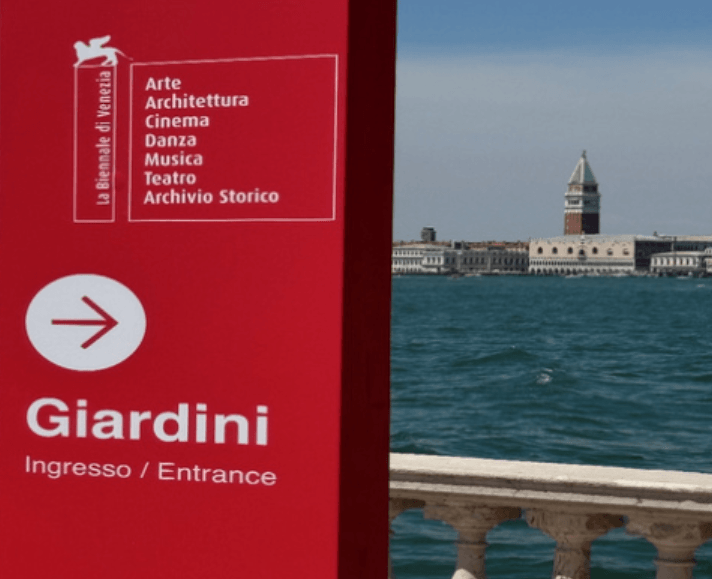
The entrance banner states that exhibits include contemporary art, architecture, cinema, dance, music, theater, and historic archives.
It is said that many contemporary artists’ careers were launched or elevated at these events.
As a permanent location for this international event, some twenty-nine countries have constructed their own permanent national pavilions through the years in Venice’s Giardini exhibition park. Belgium constructed the first exhibit hall in 1907 with the United States completing their pavilion in 1930.
HOW DID I HEAR ABOUT PORTABLE RESTROOMS INVOLVED IN BIENNALE AND HOW WAS I ABLE TO ATTEND THIS EVENT?
Fate … (This story is almost as amazing as I later found the exhibit to be!)
Our good friend, Tonya Roberts with J & J Sanitation Products, had kindly proofread the article that I had written on the 2016 Hamberg Art Show. As part of my “proofreading team,” she made several great suggestions and – as I always say – the more people that can proof my rough drafts, only make the final articles better.
After reading about an art exhibit that featured portable restrooms ten years ago, she did some additional research to see if our industry was represented elsewhere in “the world of art.” On May 18 of this year, Tonya emailed me with the quote of “this is weird” but she had found a current art show in Venice, Italy that was featuring portable restrooms as exhibits.
My response to her was that “this is weird and getting weirder.” You see, Tonya had no idea that on May 27th (9 days away), Terri and I were traveling to Venice to spend 3 days there before going on a cruise from Venice to Athens, Greece in celebration of our 40th Anniversary this Fall!
Fate!
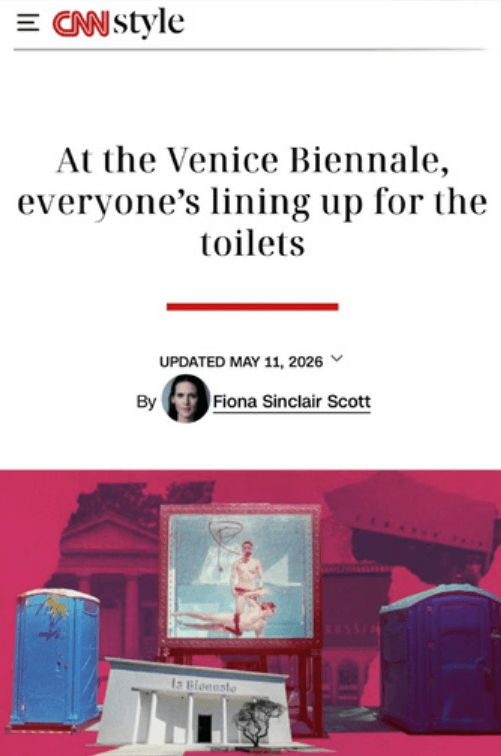
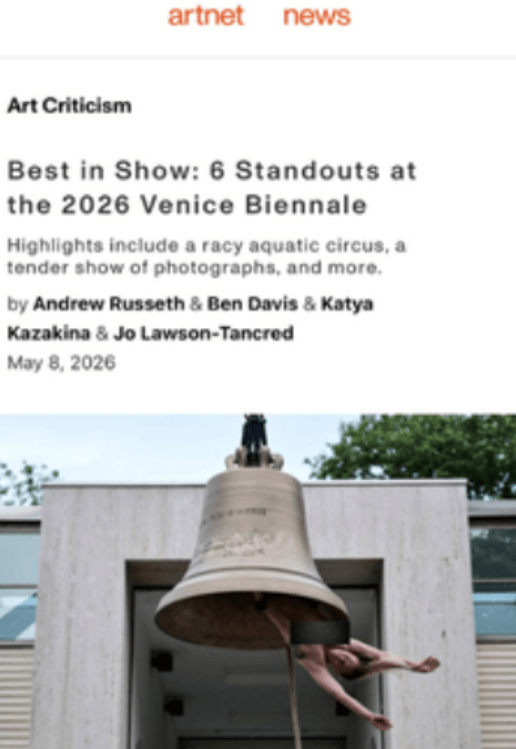
We immediately began researching this event and the reviews that we found heightened our curiosity even more. Here are some of the headlines that we came across:
MEDIA COVERAGE
 |
 |
NEW YORK TIMES, May 7, 2026
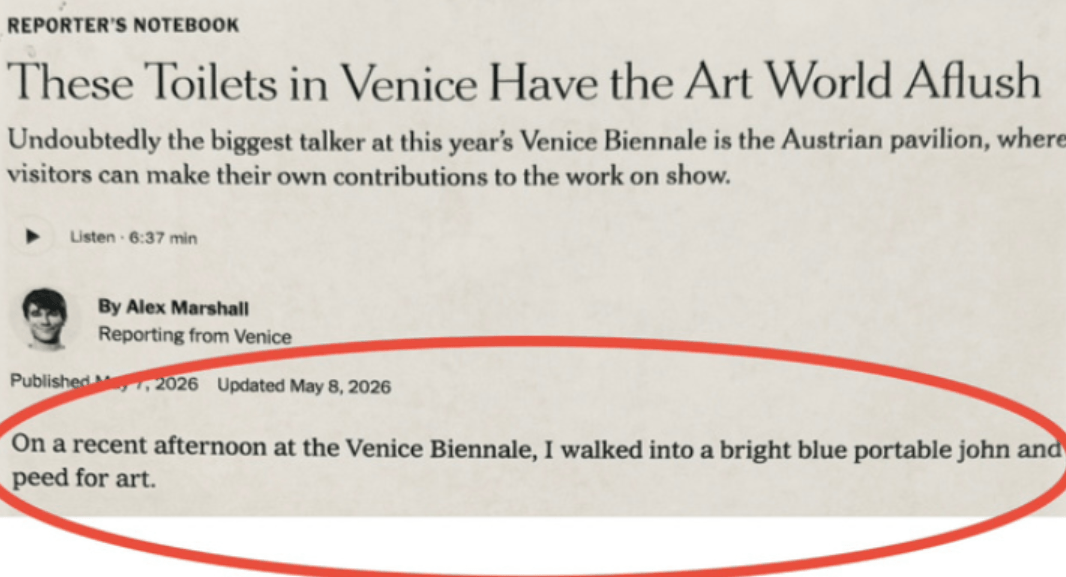
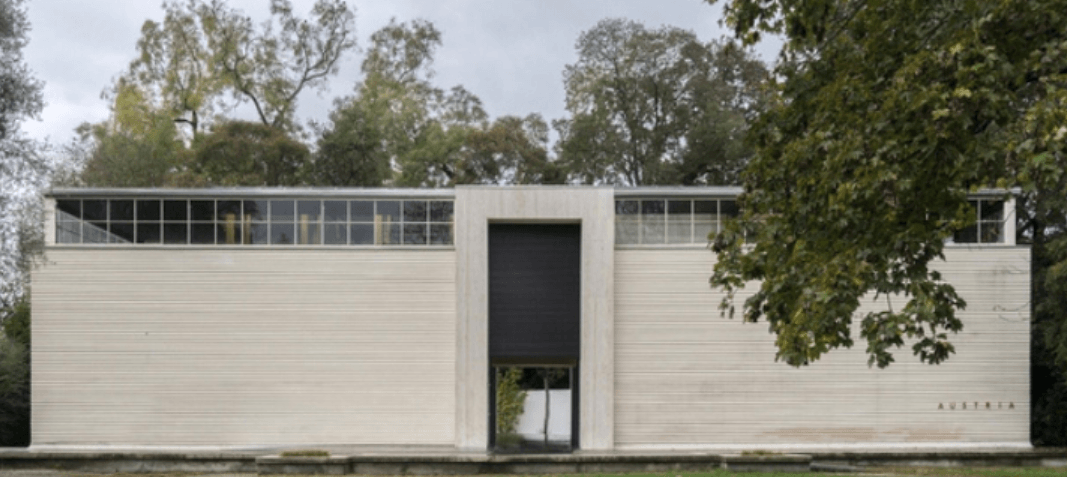
This “one-of-a-kind” exhibit was being housed at the Austrian Pavillion. Entitled “Seaworld in Venice,” this became our mission.
JOURNEY THROUGH VENICE TO BIENNALE …
On Saturday, May 30th, sadly Terri woke up with a migraine headache but she encouraged me to “adventure into the unknown” and to find this exhibit. I took the train from our hotel to the island of Venice and embarked on my adventure.
I was told to take a vaporetto (water bus) from the train station on the western end of the island to the Giardini della Biennale on the eastern end of the island. After successfully managing this task – and seeing some lovely sights along the way – I came to the Giardini and saw large red and white the entrance sign that was shown above. I had arrived!
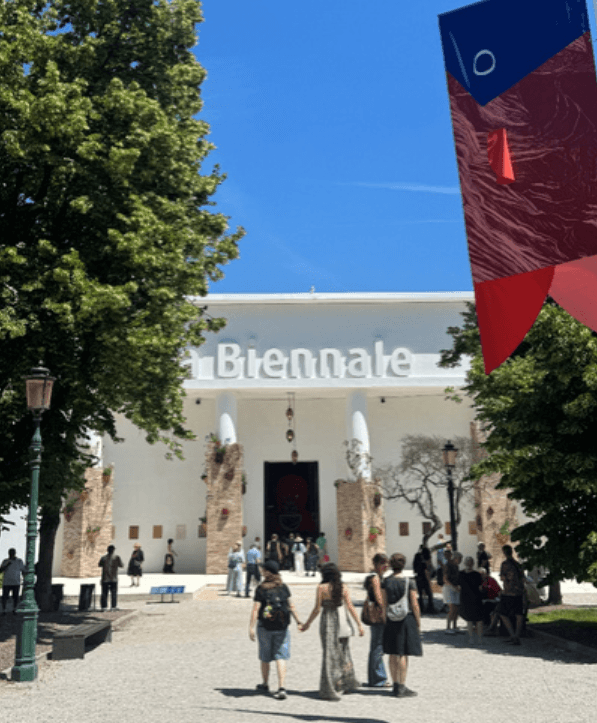
Large crowds were in and around the various international buildings as I began my search for the Austrian Pavillion.
I passed these pavilions along the way:
|
Hungary National Pavilion – Built 1909 |
French National Pavilion – Built 1912 |
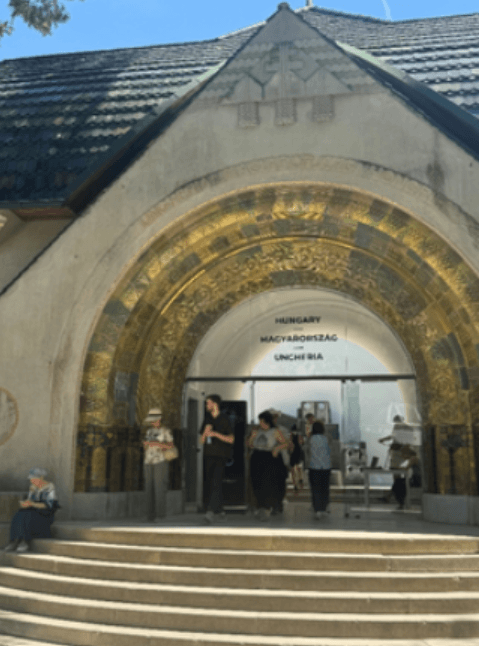
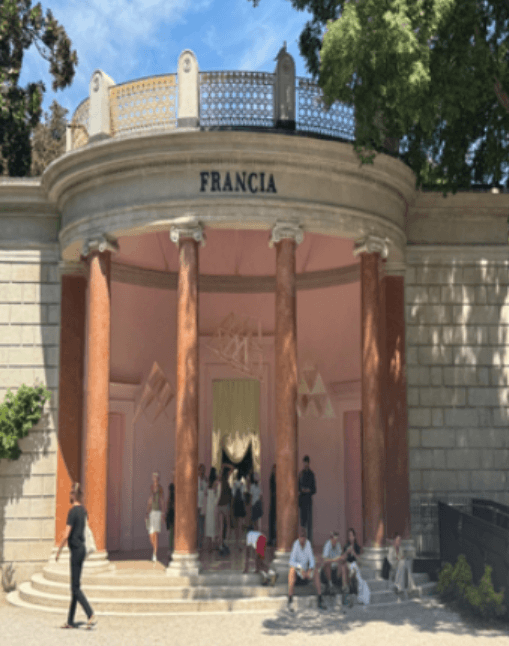
|
Canadian Pavillion – Built 1958 |
Nordic (Finland, Norway, Sweden) – Built 1962 |
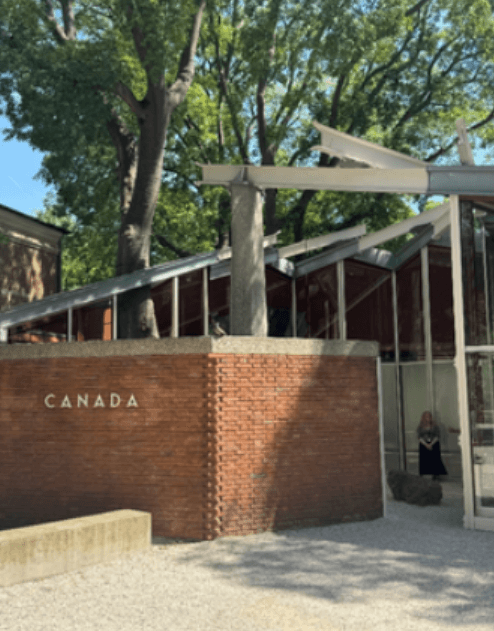
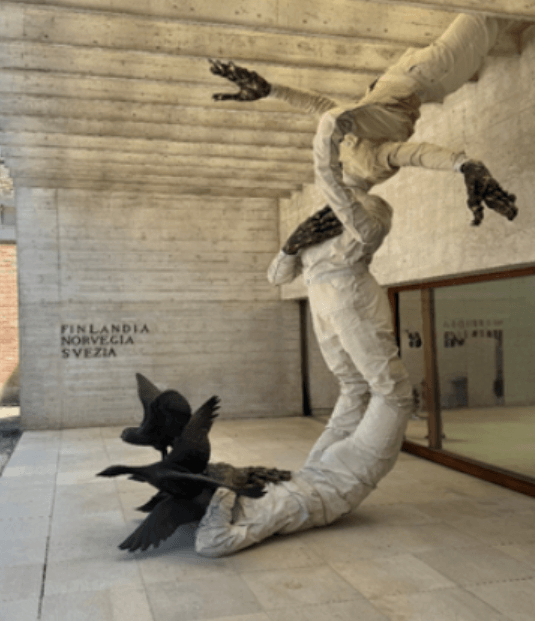
I got closer and saw many interesting pieces of modern art along the way.
Here is one just outside the Austrian Pavillion:
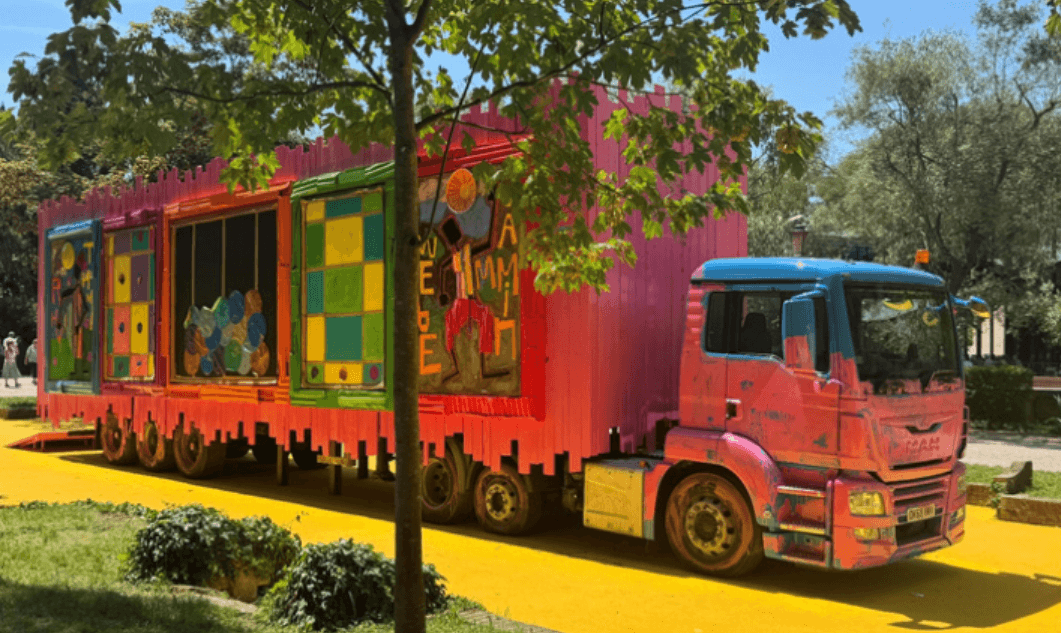
Entitled “Labor Day Parade ’91,” this work is by renowned modern artist, Alvaro Barrington. This artwork recognizes the exact date, 35 years ago, that he moved from the Caribbean to the United States.

Currently residing in London, Barrington drove this operational vehicle from London to Venice – roughly 1,200 miles!
Once he arrived at his exhibit location, immediately across from the Austria Pavillion, he finished mounting the pink planks on the truck to which he added his trademark painted burlap canvases with scenes from this time in his life. After he had completed this work, he punctured the front tires to permanently ground the vehicle as an installation at Biennale.
A more humorous description of Barrington making his truck a permanent exhibit was written by Thaddaeus Ropac in the British publication The Art Newsletter:
“Fear not – the front tyres have been punctured so that the lorry (truck) cannot move, says Barrington, preventing it from careering into the Austrian exhibition and crushing the nude performers.”
AUSTRIA PAVILLION AND THE “SEAWORLD VENICE” EXHIBIT
I finally reached my destination at around 12:30pm and was greeted with this sign:
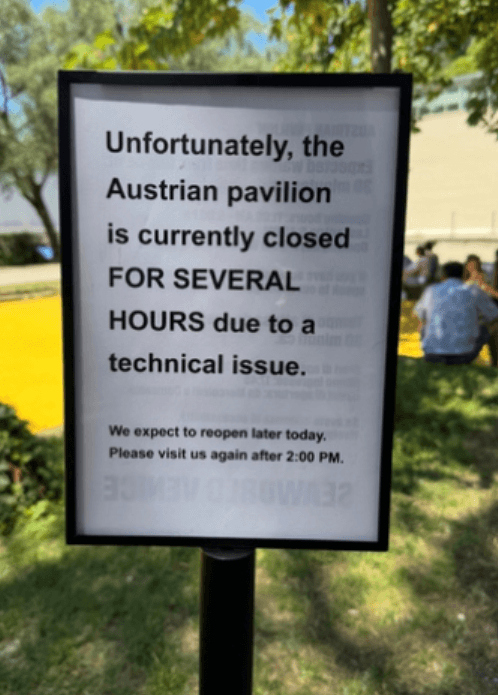
YOU HAVE GOT TO BE KIDDING ME !!!
Fortunately, I learned patience from my mom – my role model in life – and I spent an hour or so looking at other exhibits and examining Biennale in more detail. At 1:45pm I was back in line as the crowd was gathering in anticipation of viewing this popular live exhibit.
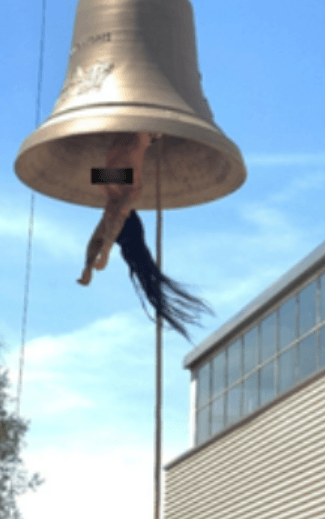
At precisely 2:00pm, the exhibit opened as the “girl in the bell” was hoisted into position and let down her hair and “Seaworld Venice” was open!
“SEAWORLD VENICE”
Portable sanitation is featured in this live-performance artwork and to say that this is a “one-of-a-kind exhibit” is an understatement!
While contemporary art speaks to each attendee on a personal level, the general theme of this exhibition, entitled “SEAWORLD VENICE,” is “sustainability.”
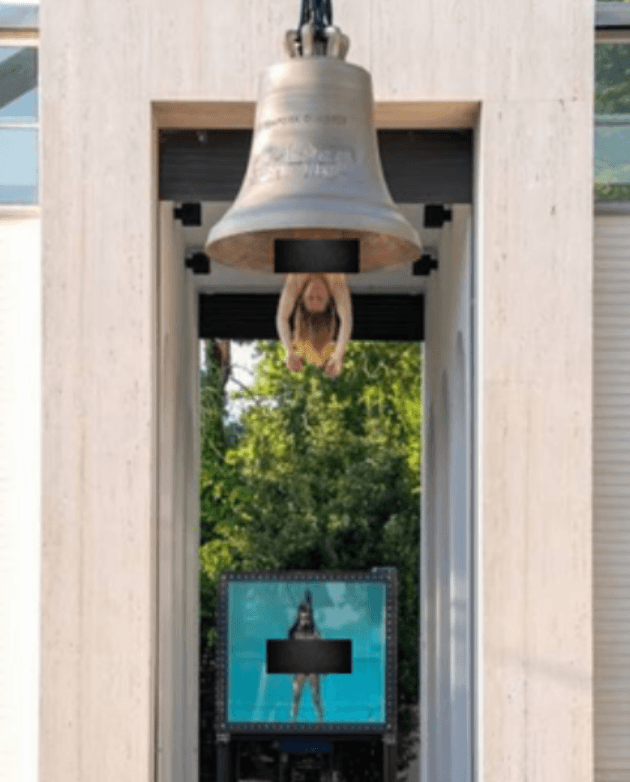
This is the main entrance to the Austrian Pavillion. Beyond the “girl in the bell” you can see the swimming cube in the distance. There is no evidence of portable restrooms from this vantage point.
Upon entering the main exhibit area, we saw the large cube filled with water and a person swimming in the nude inside this area. As we approached closer, we saw the portable restrooms (one standard unit and one ADA unit) connected to a filtering device under the swimming cube. Visitors are encouraged to urinate in the portable units. The urine is then sent to the filtration device where the wastewater is filtered to the point that it is then pumped into the water cube that the swimmers are swimming in. Does the word “unique” adequately describe this exhibit?
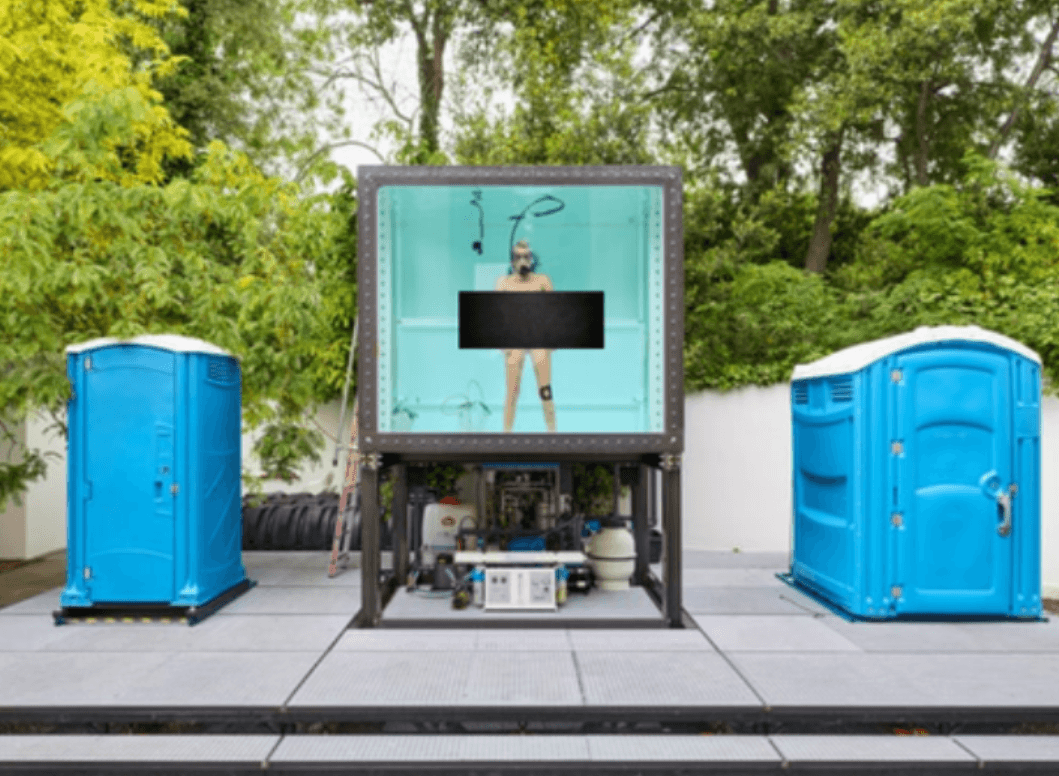
The Austrian artist that created this thought-provoking and highly acclaimed exhibit is Florentina Holzinger.
What are your thoughts about the significance and meaning of this artistic endeavor?
-
Bell at the Entranceway … Does this symbolize a welcome message to you? … A call to come together? … A warning? … A marker of the passage of time? … Other?
-
Person in the Bell … Does this symbolize a personal welcome? … A welcome to humanity? … Is this person in distress concerning the conditions of water and water pollution in the world? … Other?
-
Swimmers in the Tank … Are these people survivors of the waste and pollution conditions of the world? … Are they leaders in finding uses for recycled wastewater? … Other?
-
Portable Restrooms … Important and necessary tools in the collection and recycling of waste? … Key components in the worldwide success of conserving fresh water? … Other?
This highly unique environment where each attendee can literally participate in this process (by using the portable restrooms) allows each attendee to form their own thoughts and ideas about this exhibit. Besides announcements stating, “no photography nor videos,” the exhibit area is quite and gives time for reflection as to what we were observing.
The worldwide reviews of “Seaworld Venice” have been extremely positive and have only further increased the popularity of this exhibit.
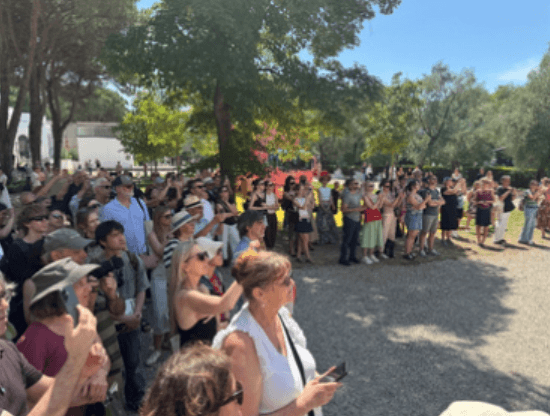
The crowd as we awaited to enter the Austrian Pavillion after the temporary closing that morning due to “technical issues.” This was the largest crowd that I saw in any exhibit area that day.
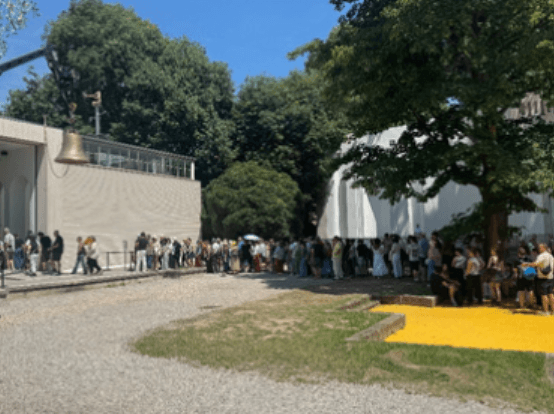
As I left the “Seaworld Venice” exhibit, the crowds were just as large.
The Work Behind the Art – SFC Umwelttechnik – Converting Urine to Water
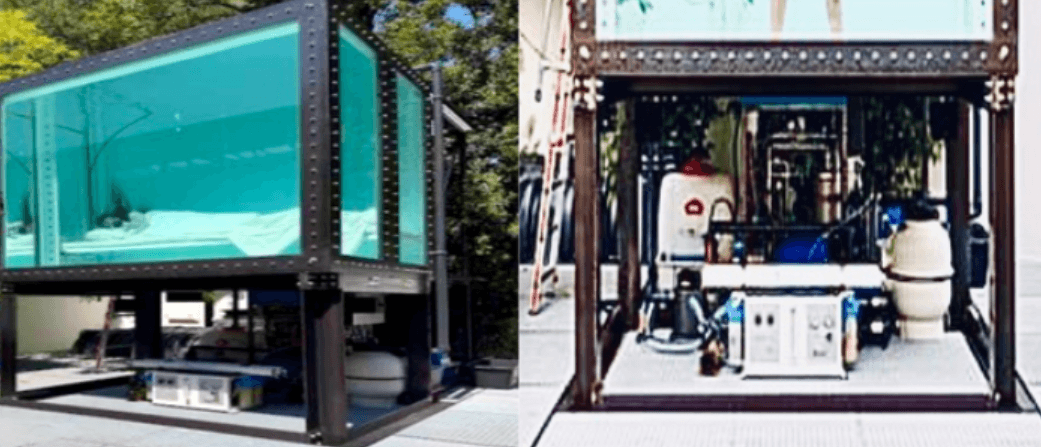
The swimmers in the cube have SFC Umwelttechnik to thank for the conversion of the portable restroom liquid waste to clean water. The conversion equipment located below the swimming cube was created and installed by this internationally known Austrian company.

Founded in 1997, SFC Umwelttechnik introduces themselves as:
“We are an Austrian company headquartered in Salzburg and have been a global leader in developing cutting-edge technologies for drinking water treatment, wastewater treatment, and water reuse for over 30 years. Our portfolio includes the planning and supply of systems of all sizes, as well as the production of high-quality core components for efficient water treatment processes.”
The company mission and vision are equally as impressive - “Clean Water, Engineered for the World.”
SFC has branches in the Czech Republic and in India. The company has provided more than 1500 plants around the world with their technologies for wastewater treatment.
Dr Simon Jabornig, Managing Director of SWC, shared that “the Seaworld Venice project was quite unique for us as well, as the urine treatment solution implemented there is currently not a part of our standard product portfolio.”
Perhaps this project will launch new technologies for our industry!
FINAL THOUGHTS
In the newsletter articles, book chapters, and blogs that I write about the history of our industry, I have always been the writer who interviews the subject matter expert. In this case, because of mere luck and timing, I became the “on the site reporter” and participant in the event. I have to say that I could not have planned a better time for this to occur.
Biennale was an interesting and unique experience that I thoroughly enjoyed – even though Terri could not attend.
In summary, our industry continues to grow and to become recognized on an international basis as being a vital component in the conservation of fresh water and in the recycling of wastewater. The previous article on the 2016 German Art Show in Hamburg and now the 2026 Biennale Art Exhibit in Venice help to publicize this effort.