MEET YOUR 1971 PSA BOARD OF DIRECTORS

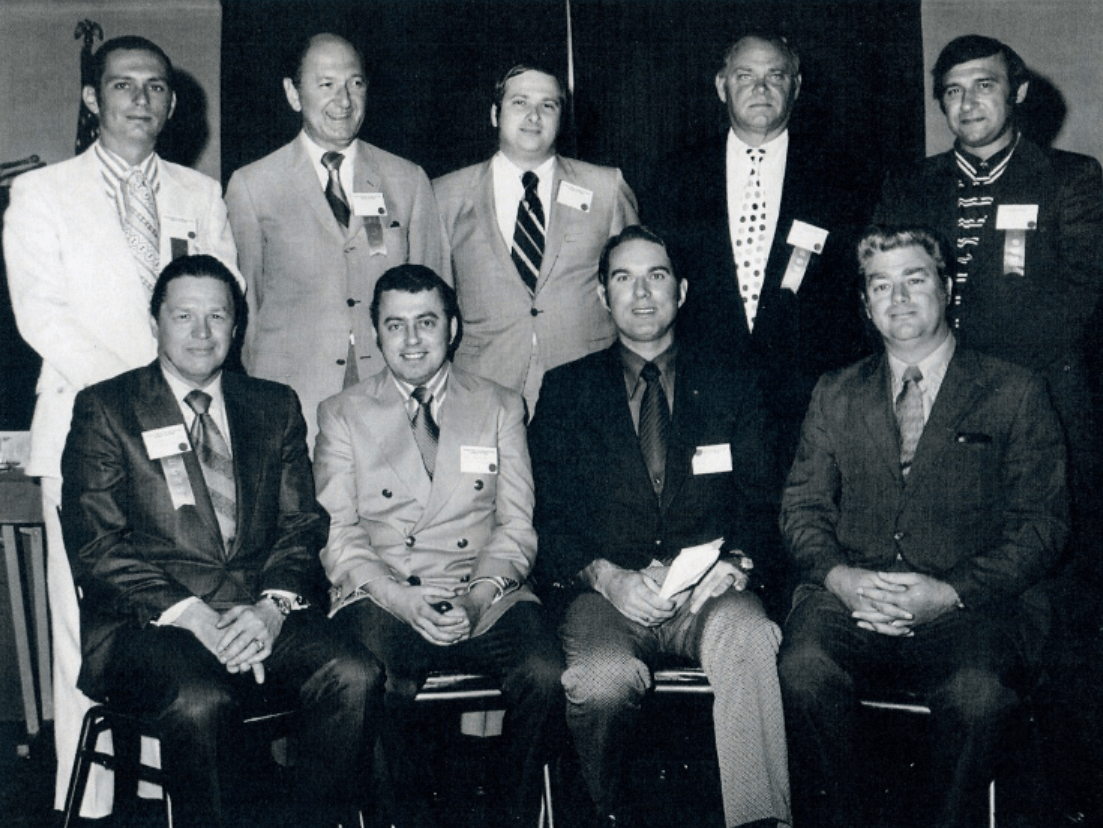
SEATED LEFT TO RIGHT: CLARENCEHENK, CHICAGO;EARLBRAXTON,DETROIT; AL HILDE, MINNEAPOLIS;FRANKPHILLIPS, ATLANTA (TREASURER).
TOP ROW, LEFT TO RIGHT;STANFORDFREEDMAN, MIAMI(VICE PRESIDENT);IRVIN JUSTER, SCHENECTADY,(PRESIDENT); PAUL LEVINE,PHILADELPHIA;ROBERTC.CHURCHILL,ROANOKE,VA.;JAMESCONSOLO,BROOKLYNHEIGHTS,OHIO.
ABSENT WERE:M.C.NOTTINGHAM, IRWINDALE, CALIFORNIA; ANDBILLL.STRATTON, SANANTONIO. ALSO NOTSHOWN IS FRANK VANBALEN, ROANOKE, ANORIGINAL ORGANIZER AND ASSOCIATION MEMBER ADVISOR TO THEBOARD VIA APPOINTMENTBY PRESIDENT JUSTER.
Through the years we have all seen this historic photo of the Charter Board Members of our Association. Who were these individuals? What were their backgrounds? How did their experiences help them to begin a new association in a relatively new industry? Here are their interesting and amazing stories …
BACKGROUND
January 29, 1971 – Washington, DC – Marriott Twin Bridges Hotel
An “Organizing Committee” meets to discuss the formation of a “nationwide portable chemical toilet operators’ association.” The name chosen was “PORTABLE SANITATION ASSOCIATION, INCORPORATED.” (Notice that this is still “PSAI” but “International” was officially added in )
Executives Consultants, Inc of Washington, DC was hired to provide support for the new PSA. President - Alfred B. LaGrasse. Chairman – William Dalton.
The Members of the Organizing Committee were:
-
Chairman- Irvin Juster - Duane Rentals, Schenectady, NY
-
James Consolo - Diamond Sani, Brooklyn Heights, OH
-
R. C. Churchill, Jr – Churchill’s, Roanoke, VA
-
Stanford Freedman – Able Builders Sanitation, Inc, Miami, FL
-
Les Mayers – Monogram Industries, Inc, Los Angeles, CA
-
Treasurer - Frank R. Phillips – Jiffie Jonnie, Doraville, GA
-
Bill L. Stratton – ABC Service Company, San Antonio, TX
-
Frank Van Balen – Virginia Fiberglass Products, Roanoke, VA
-
Advisor – M.C. Nottingham – M.C. Nottingham Companies, Irwindale, CA
March 25-26 and April 23, 1971 – Follow-up Meetings were held at this same location in Washington, DC.
May 22, 1971 – First Board Meeting held in the Chicago O’Hare Airport. Here the first PSA Board of Directors was elected and installed.
Here the story of the PSA’s Charter Board Members begins …
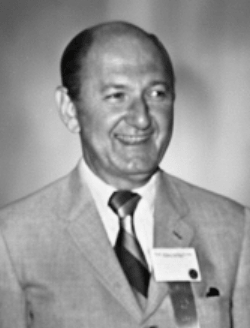
President Irvin Juster
Duane Rentals, Inc,
Schenectady, New York
Born in Tampa, Florida on April 4, 1917, Irvin lived in New York when he enlisted in the US Army in 1942 and fought in World War II. He was captured and was a prisoner-of-war (POW) at Oflag64, a German POW camp for American officers located in Poland. On January 21, 1945, with the Soviet army approaching, all able-bodied prisoners were marched in the winter cold and snow nearly 400 miles to reach another POW site in Germany some 2 months later. This experience emboldened Irvin’s leadership and organizational skills while also seeming to instill a spirit of optimism and a constant smile. In all the pictures that I have seen of him, he is always smiling.
Duane Rentals was founded in 1954 in Schenectady, NY as a trailer hauling rental business. The founder, Harold Hatkoff, has been referred to as a “pioneer in the rental business’” one of around six such businesses in the US at that time (The Times Record, Troy, NY 1976). According to this same article, he started with two “Sani-John” portable restrooms and, as of 1976, the company had “about 200 in use throughout the area.”
Irvin Juster took over ownership of Duane Rentals in the mid-1960s. With a motto of “Rent It, It’s Cheaper than Buying It,” the company continued to expand its vast array of rental products for both commercial and homeowner use. The company offered rentals of:
-
Portable restrooms
-
Trailers
-
Tools
-
Dishes and silverware
-
Roll away beds and cribs
-
Washers, dryers, TVs, and small refrigerators
Innovative, creative, and hard-working … these were the traits that Irvin Juster brought to the creation of the PSA. As the Charter President, Irvin worked to publicize this new organization wherever and whenever possible. With the headquarters in Washington, DC, one of the early goals was to educate and to inform lawmakers about the need for portable restrooms nationwide for commercial, industrial, residential, and special event use.
Leading up to and immediately after the first Convention in New Orleans in November 1971, Irvin led the Board in aggressively informing the media as to this inaugural event.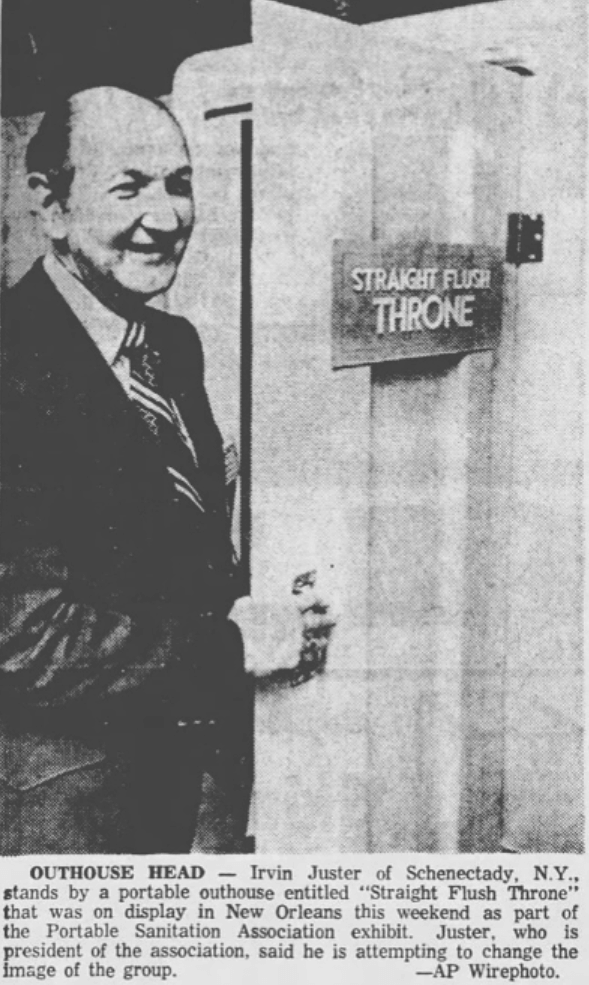
His knowledge and experience in the rental industry were further enhanced by his membership in the American Rental Association (ARA). Founded in 1955, today the ARA includes more than 11,500 rental businesses, over 1,000 manufacturers and suppliers. With members in all 50 states and more than 44 countries, this truly international association would have been a model for Irvin to share with the PSA Board at that time.
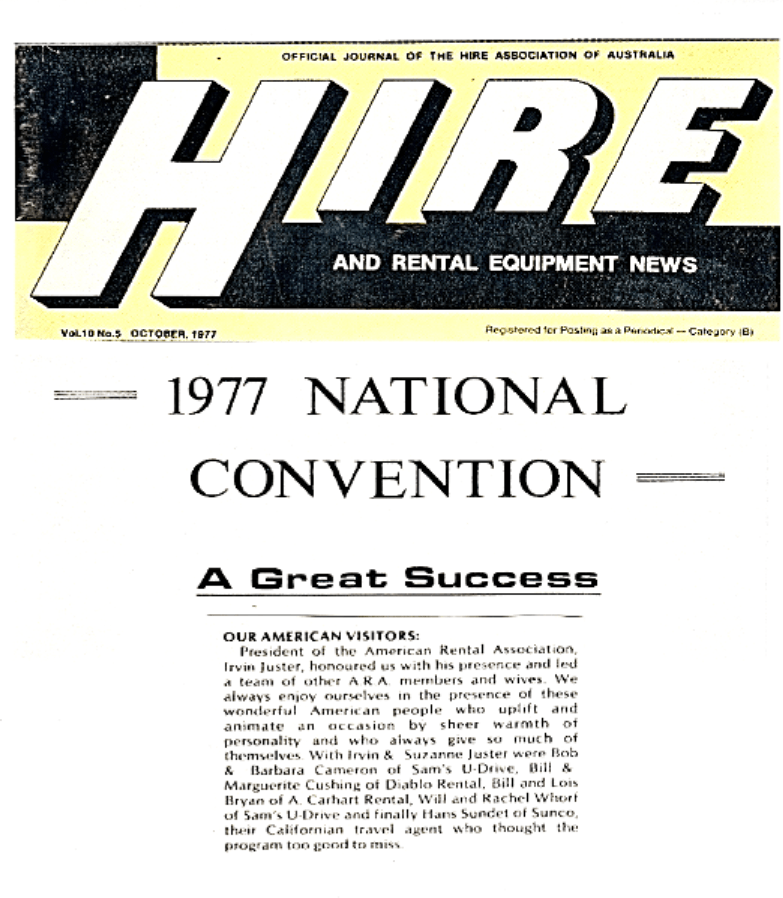
In 1977, ever the leader, Irvin was elected President of the ARA. That same year, he and his wife, Suzanne, traveled to the 1977 Hire and Rental Industry Association (HRIA) Convention in Melbourne, Australia. As an honored guest, he undoubtedly saw and visited with HRIA Past President Gordon Edsen. Interestingly, the following year, 1978, Gordon and a partner formed a portable restroom company, Rent-A-Loo, and in 1986 became a PSAI Member. Perhaps Irvin shared valuable information about the industry in the US that initiated the beginnings of portable sanitation in Australia?
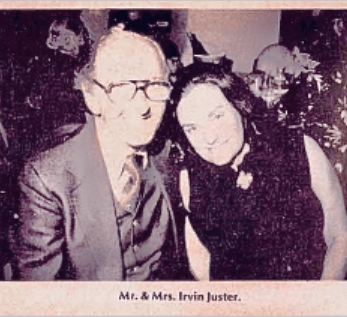
A decorated soldier, a POW, a leader, and an innovator with a worldwide perspective, Irvin Juster was an outstanding choice as our Association’s First President.
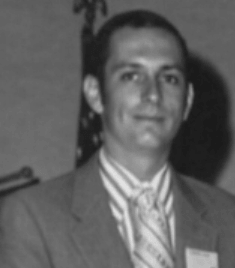
Vice President Stanford Freedman
Able Builders Sanitation
Miami, Florida
Stanford’s father - Albert “Mr Able” Freeman – began Able Industries / Able Sanitation in 1954 in Miami after moving from Philadelphia. Stanford grew up in the family business and was influenced by his father’s “can do” attitude and helpful leadership style.
Stanford was a part of the Organizing Committee and served as the Charter Vice President in 1971-72. In 1972, he became the owner of Able Industries and, as he had to devote his time to this transition, he stepped down from the Board but not from the Association. Able Sanitation was sold to United Site Services in 2001, but he continued to operate Able Export, Able Building Solutions, and Able Scaffolding for many years.
Historical sidenote … A young man in his mid-20s, Fred Edwards, visited Able Industries in 1973 and inquired about the portable restroom business. “Mr Able” was very helpful as was Stanford whom Fred rode with around Able’s service area. Later that year, with more knowledge gained from other PSA Members, Fred Edwards founded the first international portable sanitation company outside of the continental North America – Dixi. (Fred Edwards’ story is told in detail in other PSAI history articles.)
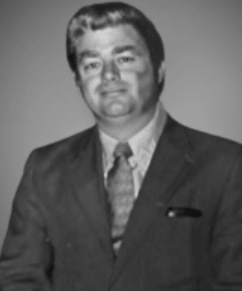
Treasurer Frank Phillips
Jiffie Jonnie
Doraville, Georgia
Frank founded Jiffie Jonnie in the small metro Atlanta community of Doraville in September of 1965. The Atlanta area began rapid commercial growth in the 1960s and Doraville was the home to the large and ever-expanding General Motors plant since 1947. Road construction was being done on a massive scale as the 66-mile perimeter interstate around Atlanta, Interstate 285, was scheduled for completion in 1969.
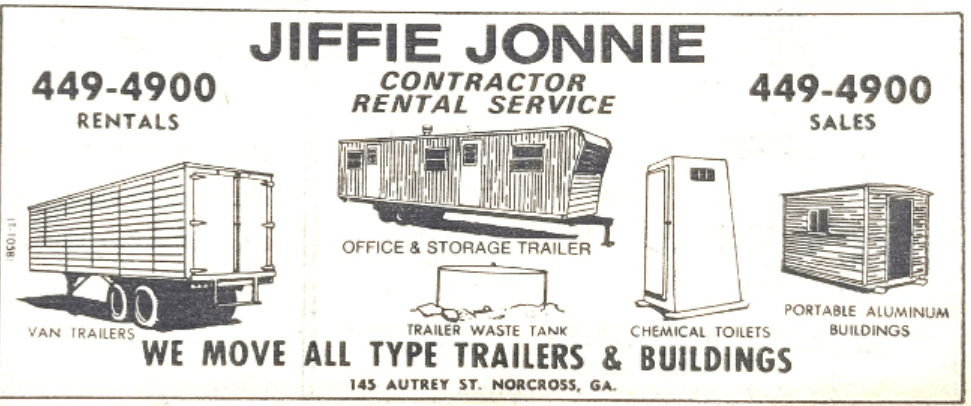
An advertisement from 1971. Frank promoted Jiffie Jonnie with professionalism as this was one of the many goals of the new Portable Sanitation Association.
As part of the Organizing Committee, Frank served in the role of Treasurer from 1971 until 1973.
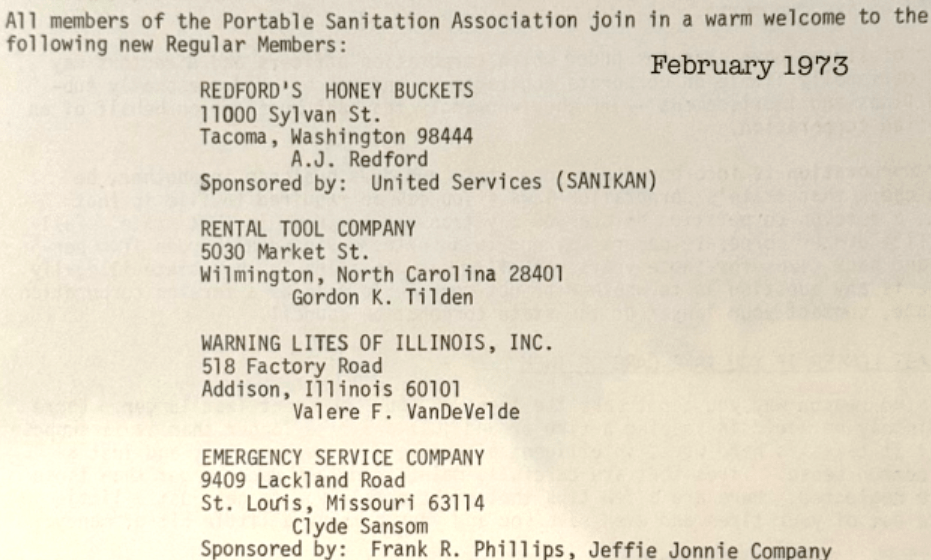
Frank Phillips was dedicated to the PSA and having recruited and sponsored many new companies during his tenure. The February 1972 “News & Views” PSA Newsletter, featured a company Frank sponsored that would one day have a dramatic impact on the Association. He sponsored a company owned by Clyde Sansom - First Andy Gump Award Recipient - and his wife, Dorothy - First PSAI Female President. The Sansoms went on to found Synergy World, a unit manufacturer that Satellite purchased in 2018. (You will also notice that another company, Redford’s Honey Bucket, joined at that same time. Quite a month for the future success of our industry and our Association!)
Frank furthered his efforts to promote and expand our industry by working to form the Atlanta Area Portable Restroom Association in 1973. He along with fellow Charter PSA Member Kermit Trulove of Cobb Porta-John and PSA Member company, Sanelect, Inc., formed this group to help to involve and share information with other companies in the Atlanta area.
Tragically, Frank Phillips died in a small plane crash on July 8, 1981, at the age of 51. This incident received much local coverage at that time.
Historical Sidenote … I was raised in Doraville, Georgia and my parents always referred to portable restrooms as “Jiffie Jonnies” in the late 1960s and 1970s. It was only while I was in college at the University of Georgia (1979-1983), that I saw and became familiar with other units. PSAI Member, The Glenn Company, owned by Past Board Member Tom Glenn, was the provider in Athens, Georgia. I began calling these units “portable restrooms” never imagining that I would be involved in this industry one day.
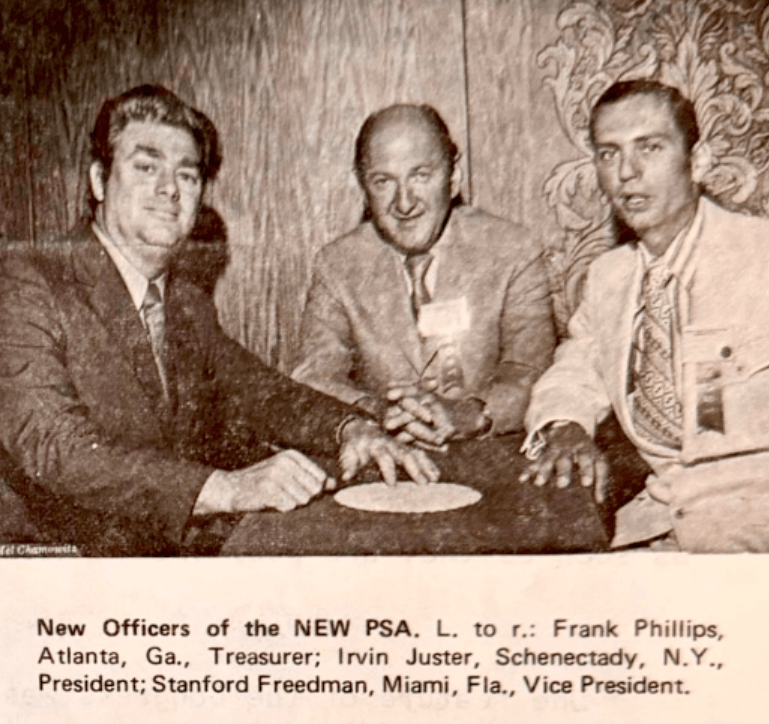
Three of the organizers of the PSA and First Executive Board Members are pictured above.
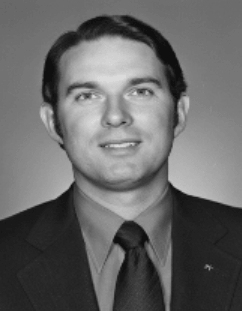
Al Hilde
Satellite Industries
Minneapolis, Minnesota
Al Hilde is a “Pioneer of Our Industry” and as such, a chapter is dedicated to him in the book “PSAI Through the Decades: A History of Portable Sanitation.” I was very honored to have Al write the “Forward” to this book – he passed away the next year.
As the founder of Satellite Industries in 1958, Al was instrumental in growing his company and our industry in the 1960s. As a Charter Board Member of PSA in 1971, he was yet another leader who helped to organize and to establish our Association.
In addition to all of Al’s accomplishments as noted in the Book, he was instrumental in developing the PSA logo.
Here is his explanation of the logo that we have proudly identified with for the last 55 years:
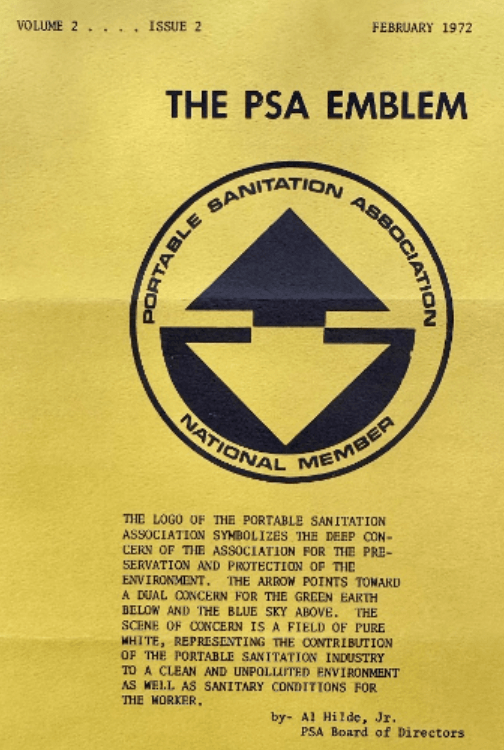
“The logo of the Portable Sanitation Association symbolizes the deep concern of the Association for the preservation and protection of the environment. The arrow points toward a dual concern for the green earth below and the blue sky above. The scene of concern is a field of pure white, representing the contribution of the portable sanitation industry to a clean and unpolluted environment as well as sanitary conditions for the worker.”
AL HILDE
February 1972

One other “Historical Possibility” is a discussion that Todd Hilde and I have had on several occasions…
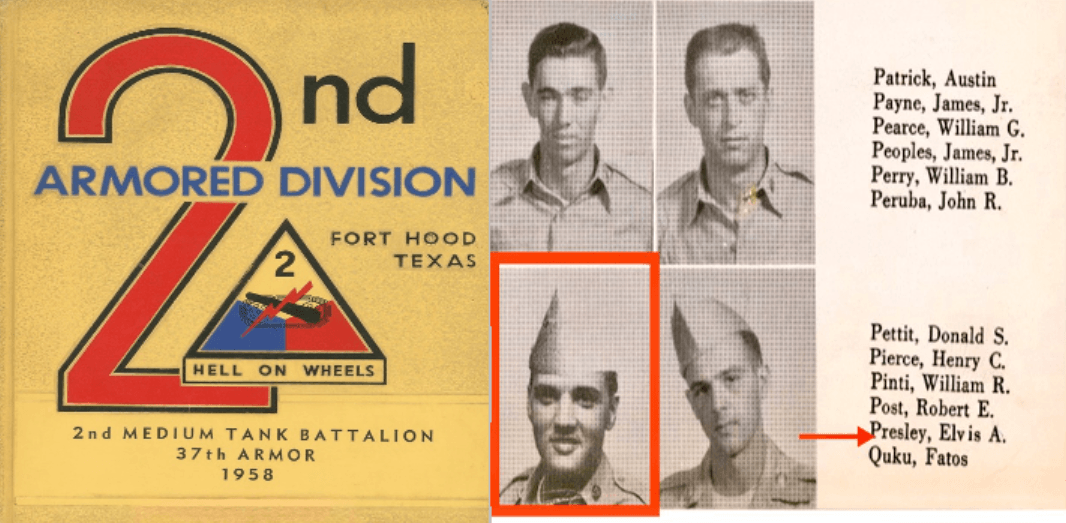
Al Hilde served our country in the US Army and was honorably discharged while stationed at Fort Hood, Texas in 1958. At that time, another soldier and international celebrity, Elvis Presley, had just begun his military service at that same base. Elvis’ platoon leader at that time was a young Second Lieutenant by the name of William V. “Bill” Wigley from Rome, Georgia – my father. Todd and I have often wondered … did Al Hilde and Bill Wigley know each other or know of each other? We will never know but we both hope so! (By the way, according to my father, “Elvis was a good soldier.”)
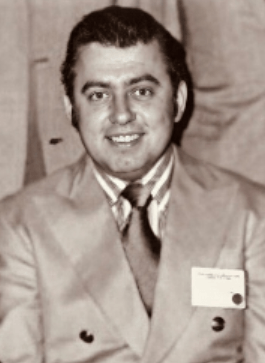
Earl Braxton
Porta John
Utica, Michigan
As of now, Earl Braxton is still involved in our industry at the age of 85! He was 30 years old in 1971 as a Charter Board Member. Those who know Earl describe him as “creative, “innovative,” and “forward-thinking.” These traits were extremely important in forming a new association.
In an April 4, 1984 article in the Fresno Bee, Earl shared a brief history of his company up to that point.
-
He was a former accountant who said that “he quit his job out of boredom” and in 1970 purchased a portable restroom company in the Detroit area, Porta-John. He grew the company substantially during the 1970s (hopefully in part due to his participation in the PSAI).
-
Famously, or infamously, in 1976, late-night entertainment host Johnny Carson sued Braxton over the use of Porta-John’s tag line of “Here’s Johnny!” and combined it with the phrase “The World’s Foremost Commodian.” Carson claimed “Here’s Johnny” as an identity slogan since he began on TV in 1957. The case was resolved in 1980 and Braxton dropped the phrase. (After Carson’s death in 2005, Braxton then again appealed the ruling, but it was denied.)
-
He began a new business – Enzymes of America, Inc. – which collected urine-based proteins from portable restrooms and restroom trailers “for resale to drug companies and universities for chemical production and research.”
Earl Braxton continued to grow and to expand his company in both the service as well as the manufacturing sectors of our industry. The company’s list of major events serviced includes:
-
1996 Summer Olympics in Atlanta (3,800 units and 42 service trucks)
-
Woodstock ’99 in Rome, NY
-
New Orleans Mardi Gras – 15 years as the sanitation contractor
-
Numerous other special events and even natural disaster service
Earl entered the “internet-world” in 1982 as a result of meeting Steve Wosniak, cofounder of Apple Computers at the US Festival in San Bernardino, CA. In a June 20, 2003, article in the Detroit Free Press, Earl shares that “Steve showed me how to run these things while sitting at the keyboard of his Apple G4.” As of 2003, Earl grew the “domain registration” business to over 700 domain names. Today, this business continues to flourish as Porta-John.
One can see that Earl’s energy and enthusiasm definitely played a role in changing the face of our industry in the early 1970s.
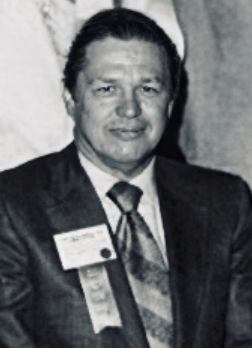
Clarence Henk
Monogram Sanitation
Chicago, Illinois
Monogram Sanitation Systems was a manufacturer of waste systems with locations in Los Angeles, Chicago, and Plainville, Connecticut. During the 1960s, the company advertised that they “specialized in onboard water and waste management” and was involved in “both sanitation equipment and aerospace applications.” Monogram offered the “Jet-o-matic” flush toilet which was very innovative at that time.
Here is an advertisement from May16, 1971 – just as our Association was coming into existence:
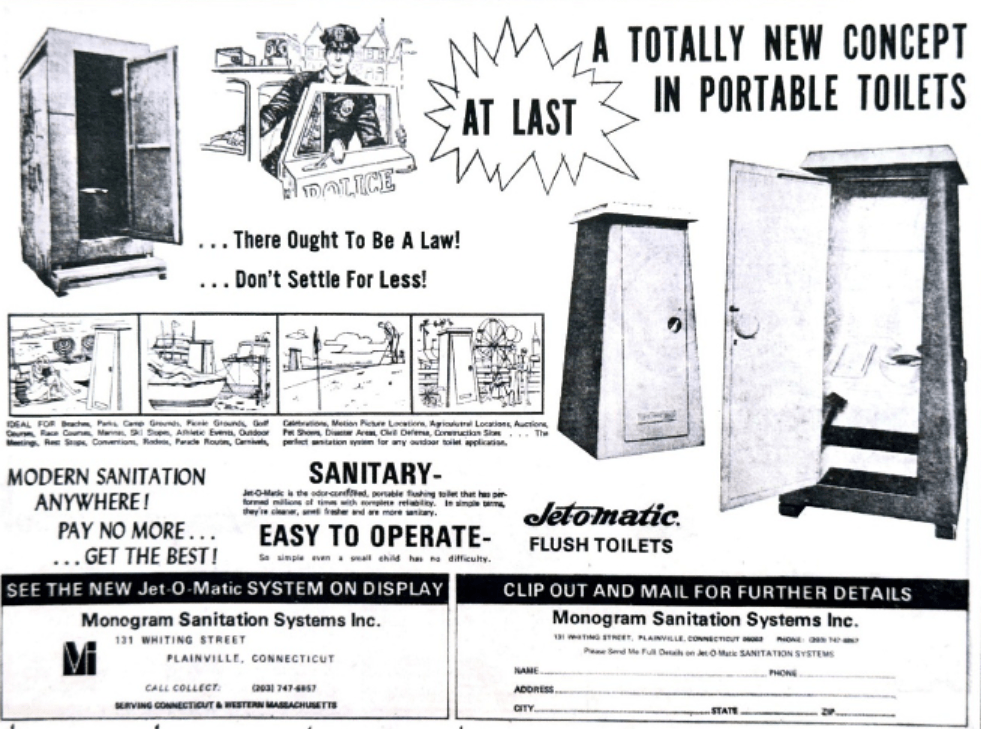
Flush toilets in 1971? Having such an innovative company involved with the PSA was extremely advantageous as the Association was striving for acceptance and credibility. Charter PSA Members were both Monogram in Los Angeles and Monogram in Chicago.
Clarence Henk was in the Chicago office and served on the Board in from 1971-73. His organizational skills from corporate experience helped in the formation of committees to further expand the PSA’s work in a variety of areas in our industry.
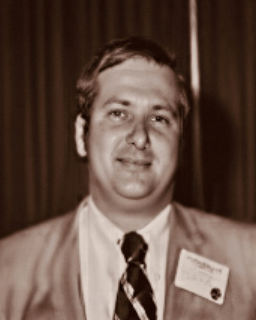
Paul Levine
Portable Toilets
Huntington Valley, Pennsylvania
Another “youngster” on the Charter Board at the age of 32, Paul Levine was an “innovator” and “think-outside-the-box” leader. He was the owner and President of Portable Toilets, Inc of Huntington Valley, PA – some 25 miles outside of Philadelphia. The company operated in 5 states – Pennsylvania, New Jersey, New York, Delaware, and Maryland.
Paul operated other companies – which is an understatement! According to the “PSA News & Views” Newsletter from April-May 1974, Paul owned Arrow Trailer Leasing which operated a diverse fleet of rental vehicles. His fleet included taxicabs, airport limousines, “Cabulances” (non-emergency medical transport), and chauffeured limousines. The total number of vehicles totaled 900 and the total number of drivers was 2,500. His taxicab company was none other than “Yellow Cab” of Philadelphia.
Just in case you have never seen a “Cabulance”:
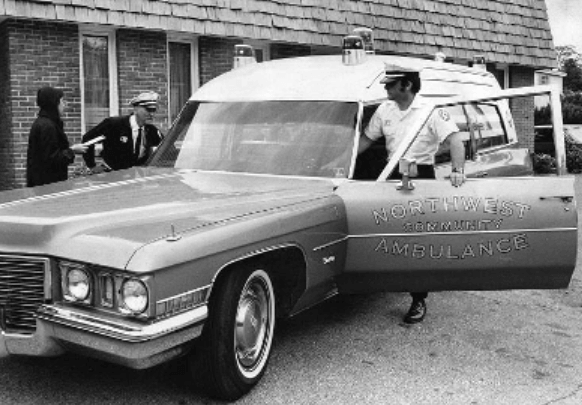
With Paul’s innovative and creative ideas, he served as the Membership Chairman as well as the Program Chairman for the Inaugural Annual Meeting in New Orleans in November 1971.
Paul Levine went on to serve as PSA President for two terms – 1973-74 and 1974-75. His ability to multi-task was an invaluable component of his leadership style and, once again, the PSA was the beneficiary of Paul’s efforts.
One final “unique” fact concerning Paul and his career … According to a July 1, 1975, article in The Indiana Gazette (Indiana, Pennsylvania), Levine made a $3.1 million offer to buy the National Hockey League Pittsburgh Penguins. He was ultimately outbid for this professional sports team.

With all the Board profiles up to this point, can you imagine the discussions of new ideas and possibilities for the new Portable Sanitation Association?
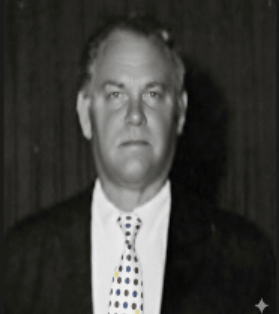
Robert Churchill
Churchills
Roanoke, Virginia
Formerly the head of Pioneer Construction in Roanoke, VA, Robert Churchill founded “Churchill’s Portable Johnny’s” in 1966. In an article from the February 5, 1967 edition of the Roanoke Times:
“One of Roanoke’s newest businesses is the manufacture and sale of portable outhouses for use at construction sites and recreation areas. They’re made by Virginia Fiberglass Products … headed by Frank Van Balen.”
Continuing …
“Virginia Fiberglass has produced about 25 here in the last six months and Churchill says 12,000 have been in use in Washington, DC.”
Finally, an excellent description of the units and the service is given to the readers …
“Made of molded fiberglass, weighing 200 pounds and available in at least five colors, they’re for sale or rent. They’re operated with chemicals and they’re serviced once a week.”
This article illustrates Robert Churchill’s familiarity with the industry standards at that time and his desire to inform the public. These skills were needed on the PSA Charter Board.
Robert stepped off the Board in 1972 but his business partner and son, Bill Churchill, carried on the family’s involvement with the PSA when he joined the Board in 1973. A hard worker and a leader, Bill Churchill served as PSA President in 1975-76.
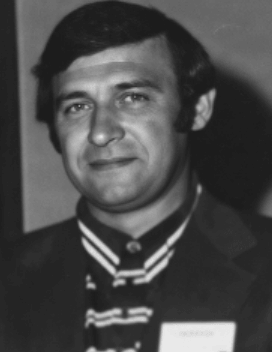
James Consolo
Diamond Sani
Brooklyn Heights, Ohio
James Consolo was an entrepreneur at an early age. At 17, he began a small trucking company in the Cleveland, Ohio area. Some 5 years later at the ripe old age of 22, he started the first portable restroom company in the city, “Red Heads.” (An interesting name … perhaps since “heads” were restrooms in miliary jargon, these wooden units were painted red? If anyone knows, please let us know.)
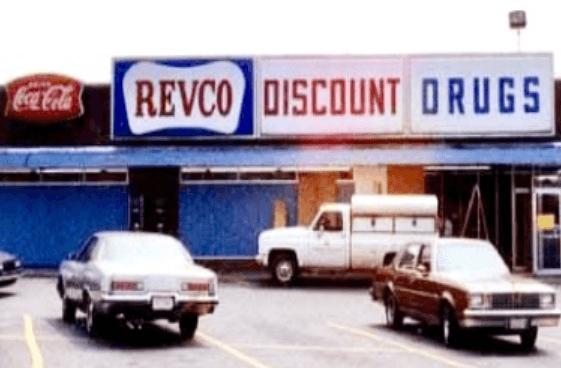
In 1966, Revco Inc – most known for the Revco Drug Store Chain – bought Red Heads. James Consolo became Vice-President and General Manager of Revco’s Diamond Sanitation Inc. Revco also purchased Waco Scaffolding in another departure from their core business.
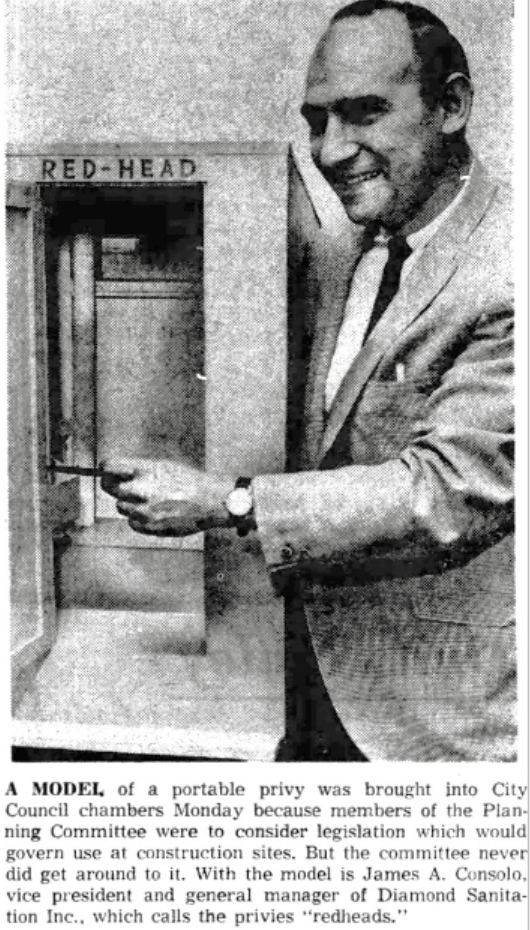
James wasted no time in continuing to advance his efforts to enact legislation for portable sanitation. In an October 17, 1967 article from The Akron Beacon Journal, Consolo is shown with a model of a “redhead” (portable restroom) as part of his presentation to the local planning committee to “consider legislation which would govern use at construction sites.”
In 1969, he was promoted to president of two of Revco’s subsidiaries. First, President of Diamond Trailer which specialized in providing mobile hauling and trash trailers to various construction industries. He was also named as President of Waco Scaffolding. Later, he was named as President of Diamond Engineered Space, a third Revco subsidiary. Clearly, James Consolo was seen as a strong leader and one that could manage multiple businesses.
James was a valuable member of the PSA Board due to his knowledge of the construction industry and exceptional managerial skills. His desire to seek legislation to establish standards for the use of portable restrooms in both construction and special events was invaluable for the new upstart PSA.
M C Nottingham
MC Nottingham Companies
Irwindale, California
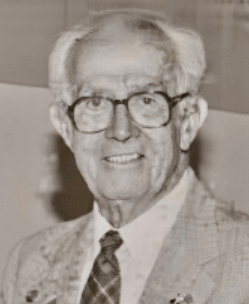
Mark C Nottingham is one of the earliest founders of our industry from the 1940s. The Sanitarian Magazine from July-August 1949 provides his life story through his company’s entry into this new industry:
-
Born in 1906 he started working with his father in the sewage disposal business in 1922. In speaking with his father about a career his father’s thoughts were:
“Regardless of how times got, there were a few necessities of life – food, clothing, transportation, and sanitation. He advised him to pick out a job no one else liked to do and specialize in it and be the best in that particular field. He talked at length about the importance of sewage disposal and sanitation and said it was a field most people kept away from.” (This was very sound advice from over 100 years ago!)
-
In 1923, according to this article, Mark was taken in as a partner by his father, and the company began operating under the name C.C. Nottingham & Son. The next year the company developed the “Hygi-Sept” a precast concrete septic tank that was revolutionary for this industry.
-
In 1930, Mark bought out his father and changed the name of the company to M.C. Nottingham Company.
-
He and his company in 1937, became Charter Members of the National Association of Sanitarians – known today as NEHA (National Environmental Health Association).
-
In World War II, the company did sanitation work in the entire western US “installing and repairing septic tanks, sewer plants and main line sewers for the Army Camps and draining fields.”
-
“Just recently (July/August 1949) Mr Nottingham has developed a new type of chemical toilet.” MC Nottingham Company was one of the earliest portable restroom companies in existence.
-
(It should be noted that according to previous PSAI history articles, Pacific Sanitary, also California-based, is thought to be the first portable restroom company as they provided service to shipbuilder Henry Kaiser during WWII. All of these early units had steps to enter due to the fact that the base was on top of a 55-gallon drum laid on its side and cut with an opening to position under the toilet seat.)
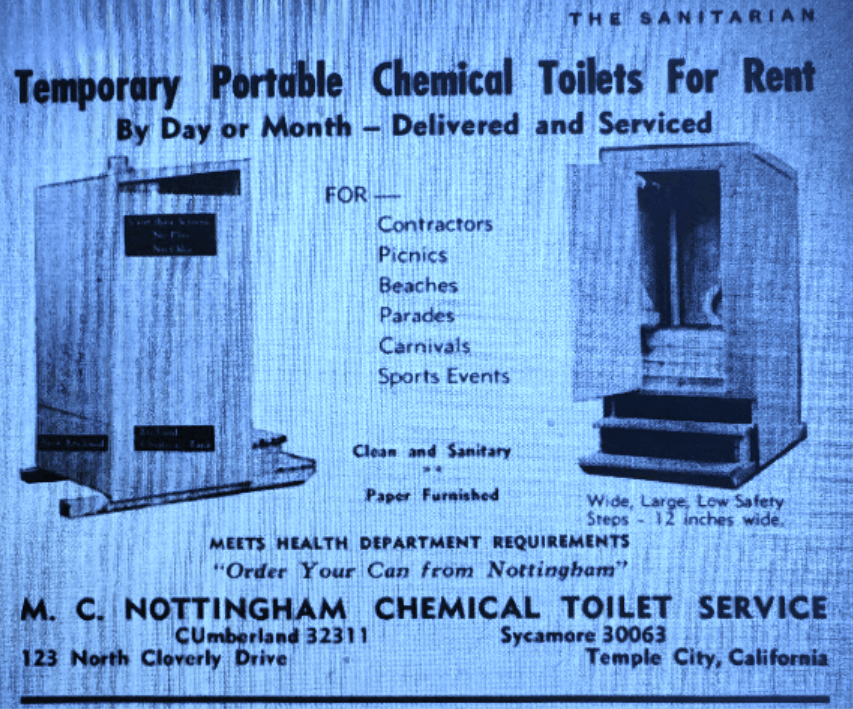
Mark Nottingham continued to innovate and to provide service throughout Southern California in the 1950s and 1960s. His joining the PSA Board in 1971 brought experience and historical knowledge to the new organization.
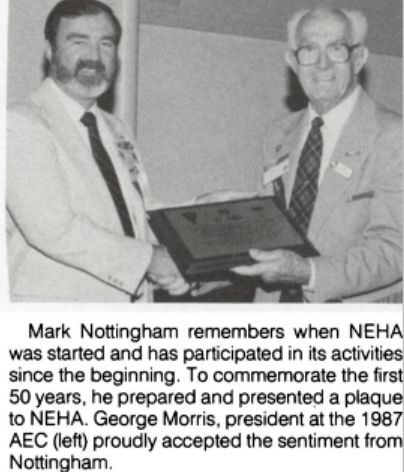
Mark Nottingham was both a Charter Member of NEHA in 1937 and the PSAI in 1971.
Bill L Stratton
ABC Service Company
San Antonio, Texas
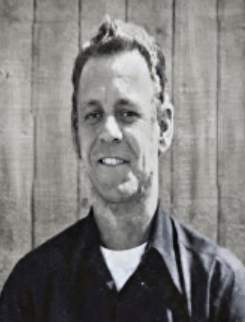
Bill Stratton founded ABC Service Company in 1958 in San Antonio, Texas and was a Charter PSA Board Member in 1971. While true, this does not begin to describe the amazing life of this individual …
He joined the Army Air Corps in World War II and served as a bomber pilot and instructor. After the war, he continued his aeronautical studies and achieved top qualifications as a flight instructor. He served as a contract pilot for the Defense Department and in 1958 he was the Chief Pilot for an oil company.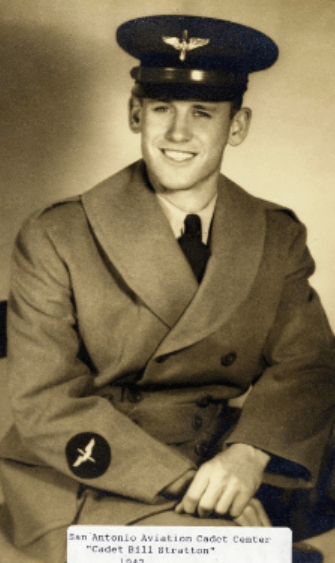
Later that year, Bill started ABC Service Company along with his uncle Richard Stratton. With his military background and desire for organization and accuracy, the company became known for excellent customer service.
In 1961, Bill was once again asked to serve his country. He accepted the position of serving as a pilot for fellow Texan – and Vice-President of the United States – Lyndon B Johnson (LBJ)! He accepted the position and began piloting what was commonly referred to as “Air Force One-Half” which was a smaller aircraft dedicated to trips by the Vice-President.
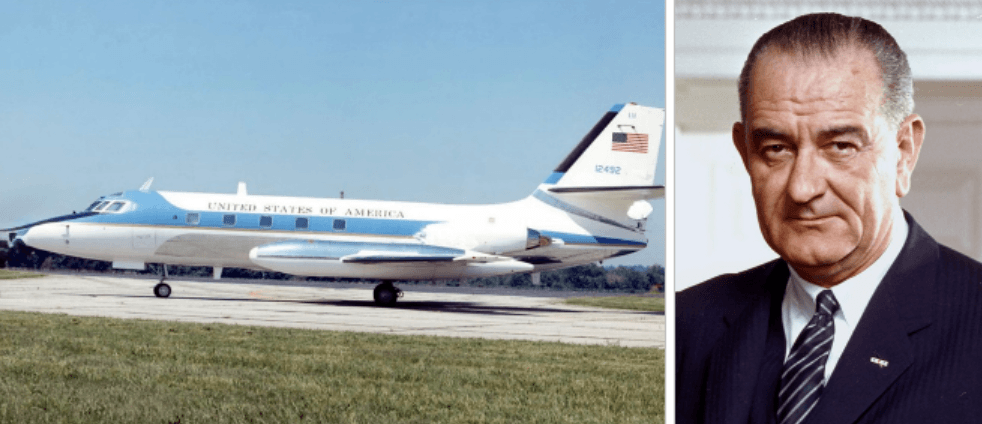
He served until 1963 when LBJ unexpectedly became President after the assassination of John F Kennedy.
When Bill returned to full-time ownership at ABC Service, the company continued to grow as the construction of both residential neighborhoods and city skyscrapers began to expand.
As a Charter Board Member, Bill Stratton offered his organization and managerial skills to the group. (He actually managed a small local airport in his area.) In 1974, he served as Vice-President under President Paul Levine. Bill was also a leading member of the Texas Portable Sanitation Association, an affiliated chapter of the PSA.
Bill retired from ABC Service in 1988, but he did not retire from aviation. He founded the “International Liaison Pilots Association” which collected and shared information about small single-engine planes that many pilots had flown in WWII. He also founded the Alamo Liaison Squadron. In his spare time, he and his wife were able to travel to various places around the world.

Frank Van Balen
Virginia Fiberglass
Roanoke, Virginia
Frank Van Balen served as an advisor to the Charter PSA Board based on his years of experience as a manufacturer and his relationships with various portable restroom companies throughout the US.
He shared his story of the founding of Virginia Fiberglass Products in an article in the Winston-Salem Journal from August 15, 1976. This article encapsulates the industry knowledge that he was able to share as a Board Member in those early days. According to this piece:
“Originally a salesman from Buffalo, NY, Frank was operating a molding shop in Roanoke (in 1964) when a man from Richmond stopped in and asked whether Van Balen could make some outhouses. ‘I thought that he was nutty and threw him out.’ But the potential customer persisted, Van Balen made 100 units for him and stored the molds in front of his shop.
Then a man from Hagerstown spied the molds … ‘It suddenly dawned on me that there was a market out there. I loaded an outhouse on a pickup truck and started calling on portable restroom dealers.”
In another article from The Roanoke Times on October 10, 1971, Frank’s company continues to grow. In 1966, he moved his business to a local industrial park and “volume increased 60% annually.” In September 1971, he moved the company again to a larger facility where production will double and “expected sales are $800,000 for this year.” His total number of employees is now 32. Here is a snapshot of the price structure in 1971:
“Sanitary units, sold at $215 apiece to a network of dealers, are rented from $35 to $50 a month to contractors. Produced in white, red, green, blue or yellow, they’re shipped by truck as far as Arizona and Florida.” (In 2026 dollars, the units would cost the equivalent of $1,751 and rental would be between $280 and $400 per month.)
Frank Van Balen took this industry experience and customer contacts with him as the PSA was beginning to be created. He had traveled extensively up to that point and was familiar with many portable restroom companies that were all potential PSA Members. His future travels also served as recruitment opportunities for the Association.
It should be mentioned that in 1972, Frank was first approached by the young mid-20s entrepreneur, Fred Edwards, who was inquiring about possibly starting a portable restroom company in Germany. Frank spoke with him from a manufacturing perspective and then referred him to Able Industries to speak with Al and Stanford Freedman (as previously mentioned).
In 1987, Frank Van Balen was recognized as the Small Business Person of the Year for the Commonwealth of Virginia. He continued to operate Virginia Fiberglass Products – now known as VFP, Inc – until his passing in 2013. This represented a nearly 50-year career serving our industry.
Historical Sidenote … As the PSA was growing in its early years, the August 15, 1976, issue of the Winston-Salem Journal gives an enlightening snapshot of the industry at that time:
“650 companies renting about 150,000 units and two dozen manufacturers stocking these companies. It is big business - $100 million annually. And it is necessary business – portable toilets are used 5 ½ billion times a year.”
The article goes on to list companies in the industry …Jiffy John, SaniJohn, Johnny On The Spot, Don’s Johns, Johnny Matic, Ar-John, Honey Pot, Ecology Can, A-1, Sani-Kan, Pee Wee, Monogram, and Satellite “to mention but a few.”
FINAL THOUGHTS
These are the stories behind the Charter Board Members of the PSAI. This amazingly diverse group of individuals came together to form a team that spawned an Association that is now 55 years old and international in scope.
From a World War II Prisoner of War to a potential buyer of the Pittsburgh Penguins Hockey Team …
From a Pilot for Vice-President Lyndon Johnson to a manager in the Revco Drug Store family of companies …
From one of the earliest founders of our industry in the 1940s to an 85-year old that is still active in our industry today …
We owe all these people a debt of gratitude for their hard work, their insight, their vision, and their love of our industry.
A SPECIAL THANKS TO EARL BRAXTON! A Charter Board Member, he has shared valuable and interesting information with me during several conversations about the organization and growth of our Association since its inception. THANK YOU!