The PSAI Presents: OUR INDUSTRY HELPS TO PRESERVE THE EARTH

Our industry serves customers across the wide range of environments – from residential neighborhoods and commercial developments to road construction sites. You will find our products and services at festivals, fairs, as well as backyard parties and weddings. And what about the most remote parts of the world? Wherever people are without permanent restroom facilities, portable sanitation plays an important role.
Let us take a tour of some remote areas of the world where portable restrooms are found.
THE ARCTIC CIRCLE
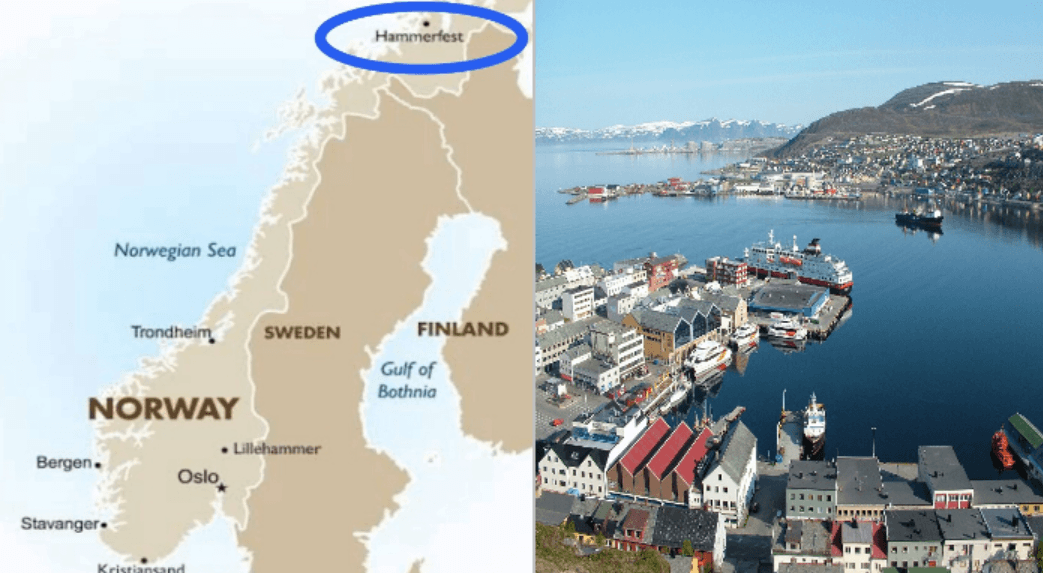
Hammerfest, Norway – “The Northernmost City in the World”
Known as the hub for polar expeditions and research, Hammerfest is located 600 miles (965 kilometers) north of the Arctic Circle and roughly 1,300 miles (2,100 kilometers) from the North Pole. With the Norwegian definition of a city as a municipality with at least 5,000 people, Hammerfest’s population of 10,000 makes this the northernmost in the world - although there are a handful of smaller settlements even further north.
The climate is tempered by the Gulf Stream such that extreme cold is rare, but the added moisture produces snow. Summer high temperatures reach between 52 – 59 degrees Fahrenheit (11-15 degrees Celsius) while winter lows are between 20 - 31 degrees Fahrenheit (-7 to -1 Celsius). With a port that remains unfrozen due to the currents, Hammerfest is home to a large fishing industry.
Tourism thrives thanks to its remarkable geographical location. This Norwegian city is in one of the few places on our planet where visitors can experience both the summer “Midnight Sun” and the winter “Northen Lights.” With continuous day light from May 16 until July 28 followed by “The Polar Night” with darkness from sunset on November 22 until the next sunrise on January 20, tourists experience a wide variety of natural wonders.

Hammerfest is located under the oval of the “Northern Lights” and during “Peak Darkness” from November 22 until January 20, the “Northern Lights” are more magnificent that anywhere else on earth.
Portable Restroom Service Providers
Being in an isolated area, the primary service providers are large national companies that rent and service a variety of rental equipment and can afford to literally establish “remote locations” in these remote locations. Three major companies that service this area of northern Norway are Loxam/Ramirent, Boels/Cramo, and Rent AS.

Loxam purchased Ramirent in 2019 and will transition the name of the combined companies to Loxam brand by 2030. The Ramirent portion of Loxam, which operates in Nordic and Eastern Europe, has approximately 300 branch offices with 3,000 employees. The company offers rental of heavy machinery, lifts, concrete mixers, drilling equipment, generators, tools, and modular equipment – which includes portable restrooms and restroom trailers. The company strategy is to offer a “one stop shop” of rental equipment in remote locations.
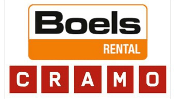
These units feature insulated walls and metallic exteriors with reinforced frames to combat winter cold, wind, and snow. Inside is a flush toilet and handwash which can be heated in the winter.
Founded in 1953, Cramo was purchased by Boels Rental in 2020. The combined organization is now the second largest rental company in Europe with 7,500 employees in 17 countries. Cramo prided themselves on a “we-can” attitude and that philosophy is now even stronger in the larger company.
 |
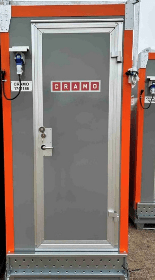 |
These heated units allow for handwash and flush to maintain sanitary conditions during the long winter months. Elevated, with steps to enter, allows for the unit to sit above the snow-covered ground. Reinforced metal walls, door, and floor provide protection from accumulating snow and ice.

Renta AS operates in Northern Europe with 175 locations and 2,000 employees. Acting as a direct competitor to Loxam/Ramirent and Boels/Cramo, Renta’s target market is Norway, Sweden, Finland, and Denmark. Renta’s offerings regarding portable sanitation equipment are more diverse, offering Sanitrax equipment and a broad range of trailer options.
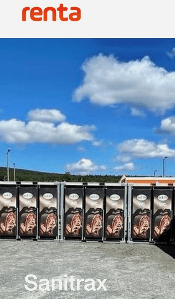
Renta’s Sanitrax units feature state-of-the-art vacuum technology. Renta also offers Sanitrax urinal stations.
Regardless of company used, it is recommended that from October and May, customers request a “vinterisolert” (winter insulated unit). These units offer “built-in heating elements to prevent the waste tank and the hand-washing water from freezing.” Hand washing is mandated in most regions and portable restroom manufacturers and operators have worked hard to meet this challenge in this part of the world.
Even above the Arctic Circle, portable sanitation companies provide their customers with equipment built to withstand extreme conditions, while providing reliable service through prolonged daylight and extended periods of darkness!
ANTARCTICA
The closest land mass to Antarctica is the extreme southern tip of South America. Ushuaia, Argentina is a port city that is surrounded by many wonders of nature. Located just south of the base of the Andes Mountains, this area features a national park, a ski area, a nearby glacier, and a scenic channel where boat tours provide opportunities to see a variety of exotic wildlife, including penguins.
Nicknamed “The End of the World” (“Fin del Mundo”), Ushuaia is the area where ships to Antarctica depart and return on their 500-600-mile (800–950 kilometer) voyages.
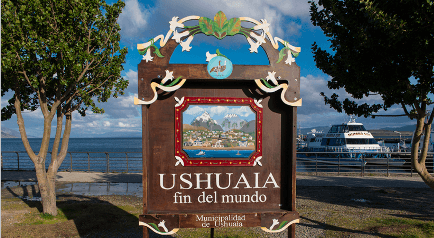
Ushuaia - “The Southernmost City in the World” has a population of 57,000.
Portable Sanitation Companies in this Area
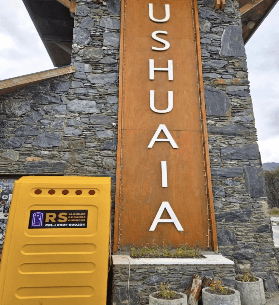
R S Banos Quimicos is the primary portable restroom company that serves this area. (“Banos quimicos” is the Spanish translation for chemical toilets.) They provide service for most of the special events in the area.
 |
 |
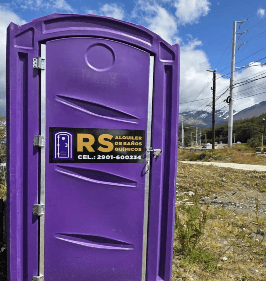 |
Their website states that “cleanliness is non-negotiable.” RS values customer satisfaction and “punctuality is another pillar” of their service strategy.
In addition to restroom trailers, RS rents security booths. They advertise that these structures “are ideal for controlling access to construction sites, events, or parking lots, providing a secure and comfortable space for security personnel.”
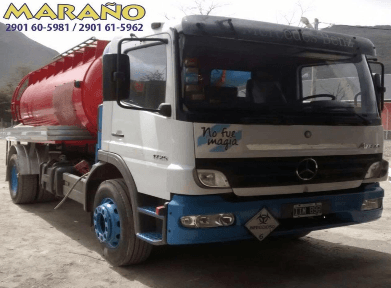
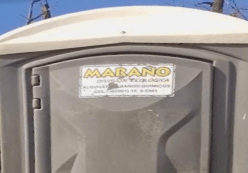
Mariano provides “banos quimicos” primarily for construction jobs, with the company’s focus centered on septic and drainage services.
Service Conditions at “The End of the World”
Portable sanitation companies are faced with unique challenges based on the geography of the area:
-
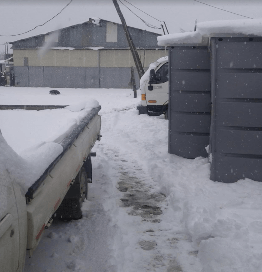
Winter - The “Snow Season” extends from June to September and brings an average of 3.3 feet (1 meter) per year. Average winter temperatures range between 29 and 42 degrees Fahrenheit ( -2 and 5.5 Celsius) and an average of 7 hours of sunlight per day.
-
Summer - December to March is classified as “moderate” with temperatures ranging from 43 to 57 degrees (5.5 to 14 Celsius). In the peak summer months of December and January, there is an average of 17 - 17.5 hours of sunlight per day.
-
Weather conditions frequently change due to the area’s proximity to the convergence of the Atlantic and Pacific Oceans. This makes rain a constant possibility.
As far as industry regulations, the Argentina Superintendency of Occupational Risks requires mandatory units on all construction sites and separate facilities for men and women for every 20 workers.
“The End of the World” is well-served by these companies, and others, in this remote area.
HIGH ELEVATION
Further to the north of Ushuaia, along the Andes Mountains is La Paz, Bolivia. At an elevation of 11,975 feet (3,650 meters), La Paz is known as “the world’s highest capital city.” Unbelievably, it is in a canyon, surrounded by snow-covered Mt Illimani (21,122-foot or 6,438-meter elevation) overlooking the city.
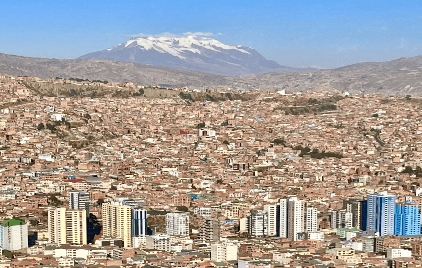
With a population of 755,000, La Paz has a rich history. Founded in 1528 by the Spanish conquistador Mendoza, this area was part of the Inca civilization. Many festivals and special events are held here on an annual basis.
The climate is unique. Average monthly high temperatures for the entire year fluctuate slightly between 62 and 66 degrees Fahrenheit (16 and 18 Celsius). Located only 1,100 miles (1,770 kilometers) south of the equator, it is the city’s elevation, not latitude, which determines its winter weather.
The winter - June through August - has highs of 62 and lows of 30 with dry conditions. Snow fall is light, usually only a rare dusting that melts during the midday warmth. Special winter service of units is not needed in the city. The outlying areas in higher elevations do have higher amounts of snow which could require special servicing.
The summer - December through February – has highs of 66 and lows of 44 Fahrenheit (highs of 16.5 and lows of 6.5 Celsius) and plenty of rain. These conditions affect driving as well as the ability to reach units for servicing.
The La Paz economy is driven by the mining industry with gold, zinc, and tin mines being prevalent in the area.
Portable Sanitation
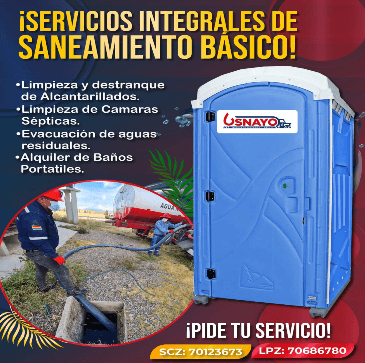
One of the major portable restroom companies in La Paz is USNAYO. In addition to portable sanitation, they also provide septic and waste hauling services.
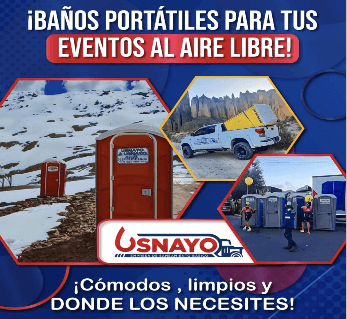
Events - both in the metropolitan area and in higher elevations - are serviced by the company.
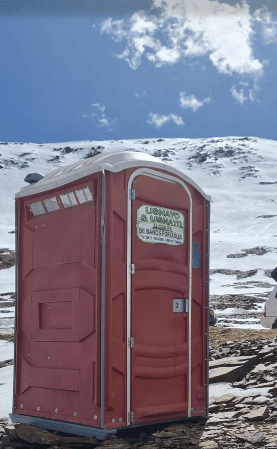
Construction and residential services are part of the company’s standard operations.
The mining industry - as previously mentioned - is unique and presents several challenges to portable sanitation companies in this area and beyond.
Mining Safety Hazards:
-
Among the most serious concerns are rockslides and ground collapse. As digging is done, layers of rock can move, shift, or completely give way. Large heavy hauling trucks and excavation equipment outside the mine can crash, sink, or overturn due to ground collapse.
-
Heat exhaustion can occur in these confined spaces with little air flow.
-
Inhalation of particles of coal dust, asbestos, heavy metal, or silica dust are a health concern.
-
Gases released during mining operations can include methane (flammable), radon, and diesel gas emissions can create hazardous situations.
-
Electrical equipment can generate sparks which can start fires.
Portable Restrooms at Mining Locations:
At some locations, units are placed outside of the entrance to the mines. At other locations, the units are inside the mine and present several service concerns.
-
Openings to certain mining areas are narrow and require precise control of the vehicle.
-
Some mine shafts are “one way in and one way out” so coordination of traffic flow is crucial.
-
Turn around areas after servicing can be limited and require backing out of the mine to exit.
-
Lighting is a concern as portable units may not be in the most well-lit areas of the mine.
-
Exhaust from the PTO pump can affect air quality and air flow in the area.
DESPITE THESE CHALLENGES, portable restroom operators throughout the world, service units in mines.
Regarding Portable Sanitation at High Altitudes …
Mount Everest 29,032 Feet (8,849 Meters)

An interesting aside … Although portable restrooms are non-existent at the world’s tallest point, the Mt. Everest Base Camp does have a portable sanitation system.
There have been 12,884 successful ascents of Mt. Everest since 1953. In 2019, a record 877 successful ascents were made.
The number of visitors to Mt. Everest is much larger than you would expect. Over the last 20 years there have been 40,000 - 60,000 hikers per year visiting the Everest Base Camp (elevation of 17,598 feet or 5,364 meters). During peak season, some 500 people per day reach Base Camp - all in an area with no trash containment and no portable sanitation!
Quite naturally, there is a significant trash problem in the upper elevations of Mt. Everest that has existed for many, many years. Thankfully, there is an organization - Sagarmatha Pollution Control Committee (SPCC) that is working to combat this issue, and a portable sanitation system is part of this plan.
In addition to initiating a “poo bag program” in 2024, the SPCC manages a program in which “toilet tents” are available with a sealed 55-gallon “blue drum” beneath the toilet seat to capture the waste. (Does this sound familiar? The industry’s first units during World War II were almost exactly like these 2024 models!) When capacity is reached, the barrel is sealed and literally rolled down to the next closest camp.
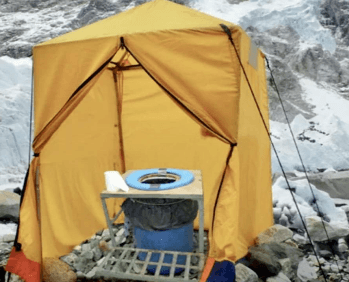
There are similar “toilet tents” in each of the 4 camps leading up to Base Camp. A fee is charged to assist with disposal of the waste.
The SPCC and other environmental groups have quite a challenge ahead in terms of waste
control. According to Explorersweb “it is estimated that in 2023, Base Camp generated 75 tons (165,350 pounds or 75,000 kilograms) of waste, including 21,507 kg (47,415 pounds) of human waste.” Hopefully, these programs will succeed as worldwide awareness increases.
REMOTE ISLANDS WITH NO ACCESS FROM THE MAINLAND
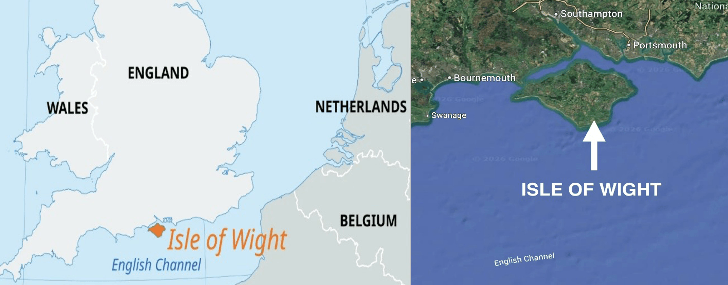
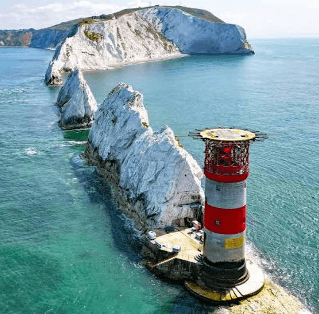
The Isle of Wight is an island in the English Channel located 5-6 miles off the coast of Southern England. The 150 square mile (388 square kilometer) island is comprised of over 100 square miles (260 square kilometers) of farmland, 20 square miles (52 square kilometers) of natural areas, and only 20 square miles (52 square kilometers) of land considered as “developed.” With a population of 141,000, there are 9 towns with the largest, Ryde, having a population of 30,000. This island has been designated as a UNESCO Biosphere Reserve of Abundant Wildlife.
To reach the Isle of Wight from the mainland, one must take one of six ferry routes that vary in length between 1 and 1.5 hours. Once you arrive at “the Sunniest Place in England,” the seashores and the landscapes are breathtaking.
 |
 |
THE ISLE OF WIGHT FESTIVAL
One of the best-known annual worldwide events held in this area is the Isle of Wight Festival. This music concert festival began in the summer of 1968 and drew an estimated crowd of 10,000 “peace, love, and rock-and-roll” fans.
In 1969, back in the United States, the Woodstock Music & Art Fair took place in Bethel, New York from August 15-18 and drew a crowd of 400,000. Two weeks later, the Second Annual Isle of Wight Festival saw a crowd of 150,000. Inspired by Woodstock, attendance was greater than the population of the entire island!
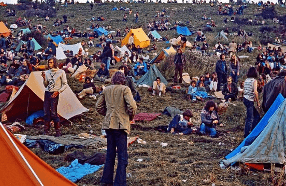
With no “Woodstock” in 1970, how large would this event grow?
The list of performers for the 1970 Isle of Wight Festival reads as a list of “All-Time Musical Greats”:
- Jethro Tull
- Chicago
- The Doors
- Joni Mitchell
- The Who
- John Sebastian
- Emerson, Lake, and Palmer
- Jimi Hendrix
- Joan Baez
- Moody Blues

This event in 1970 drew an estimated 600,000 people! Guiness World Records certified this as the largest rock concert of its time and “a landmark in rock history.”
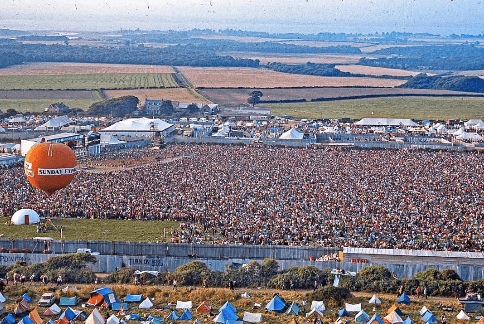
QUESTION: How did all the fans, the bands, the stages, the lights, the stands, and, yes, the portable restrooms (even though they probably fell far short of the adequate number needed) get on the Isle of Wight?
ANSWER: Ferries, ships, boats, and possibly a few small planes. Once again, the portable sanitation industry was involved in going to any lengths necessary to serve the needs of the public.
Apparently, the massive crowds left behind trash, debris, damage, etc. that was costly to remove, replace, and repair so the 3-year event was cancelled for the foreseeable future.
In 2002, the festival was reborn as the Rock Island Festival. New ordinances have been written over the past 30 years; additional safety and sanitation rules are now in effect. The attendance was estimated at 45,000 and I suspect that additional units and service trucks were ferried from the mainland to accommodate this crowd.
In 2003 the concert was rebranded “The Isle of Wight Festival” and has become an annual tradition since that time drawing an average of 55,000 to 60,000 per year. The event was cancelled in 2020 due to COVID and in 2021 a record 70,000 attended. This new level of attendance has now become the new standard.
Portable Sanitation Challenges
The unique location of this large event presents several challenges which portable sanitation providers must address:
-
Transportation of equipment – If there are units, sinks, trailers, and trucks on the Isle of Wight during other times of the year, there would most likely not be enough for this huge festival, so additional equipment – or all equipment - must be ferried over. Working with the event coordinator and the ferry transport company, exact times of departure and return must be determined. What will the cost of transport be for the equipment and supplies?
-
Service personnel – with a multi-day event, equipment will need to be serviced, and attendants will be needed for the restroom trailer(s). Will these employees need to spend the night at the event? What accommodations will they need?
-
Disposal of waste – Will holding tanks need to be used during the event so that service trucks can continue to service units? Will a septic company need to be employed to collect waste from the service trucks? Once a truck is full of waste, will it be ferried back to the mainland to dump?
-
Other – Not being familiar with all of the organization of this event, there are surely other questions to be answered and details to be resolved.

Portable Toilets Limited handled the portable sanitation needs for this festival for many years. PTL’s closest location to the Isle of Wight is in Basingstoke, southwest of London, a one-hour trip to the Portsmouth port. Once at the port, the ferry to the Isle of Wight is 1 to 1.5 hours. This was quite a commitment by PTL to provide units for this Festival.

AMP Hire, founded in 2015, and located in Downend on the Isle of Wight, has handled the festival for the last several years. Located on the Isle is a definite advantage for the requirements of this event.
The Isle of Wight Festival is a challenge that portable sanitation has been overcoming for years.
FINAL THOUGHTS
Our industry should take pride in the work that we do and in the services that we provide. Portable sanitation provides sanitary conditions for the general public, saves fresh water, and the waste is recycled back into the environment.
As can be seen from these examples … from the “Gateway to the Arctic” to the “End of the World” … from the mountains and mines of the Andes Mountains to the Base Camp of Mt Everest … and from a small island with a big event that is primarily accessible only by sea, we do what we have to do to do our job – and we do it well.
DID YOU ENJOY THIS ARTICLE? FIND MORE INFORMATION LIKE THIS IN THE PSAI INDUSTRY LIBRARY.
SINCE 1971, THIS INTERNATIONAL ASSOCIATION HAS WORKED TO IMPROVE PORTABLE SANITATION … TO EDUCATE, TO TRAIN, AND TO SHARE INFORMATION WITH MEMBERS.
JOIN TODAY AT WWW.PSAI.ORG
CONTACT US AT 952-854-8300